From Stevie Wonder to Ed Sheeran: Cliff Cooper and the Sound That Made Orange Part of Music History
- Escrito por ISP Music & Producer
- Publicado en ENGLISH

From the first amplifiers used by Fleetwood Mac and Stevie Wonder to its latest digital developments, Cliff Cooper reflects on a career shaped by electronics, recording and a highly personal understanding of the relationship between musicians and their equipment.
Orange Amplifiers has been part of the history of British amplification since the late 1960s. Its distinctive aesthetic, instantly recognisable by its use of the colour orange, was accompanied from the outset by a design philosophy focused on delivering a clearly differentiated sonic response and playing experience.
The company was founded in 1968 by Cliff Cooper, initially operating from a small shop in London’s West End. What began as a retailer of instruments and second-hand equipment would eventually become an amplifier manufacturer associated with some of the most significant recordings in popular music over the past several decades.
In a conversation with Celestion, Cooper revisited the origins of the brand, his experience as a musician and technician, the development of his first amplifiers and his perspective on the future of an industry in which digital processing and artificial intelligence are playing an increasingly prominent role.
From electronics to the recording studio
Cooper’s first professional involvement with technology came through his work as a television engineer. This provided him with a solid foundation in electronics, which he would later apply to the design and maintenance of audio equipment.
At the same time, he played in The Millionaires, a band that released a single produced by Joe Meek which reached number twelve in the British charts. When that chapter came to an end, Cooper decided to focus on three areas that were already closely connected for him: music, recording and electronics.
His original intention was to build a professional recording studio. To do so, he found an old, run-down premises with affordable rent in central London. Needing to generate enough income to keep the space running, he painted the shopfront orange and began selling used instruments and equipment.
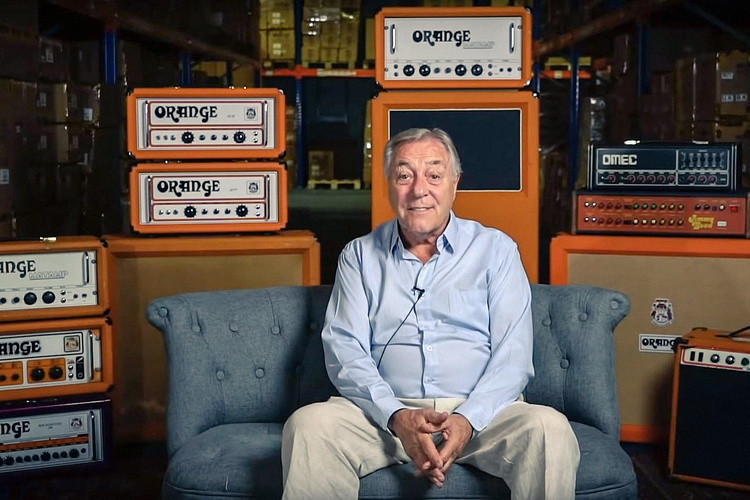
The visual decision suited the psychedelic atmosphere of late-1960s London, but it also developed into a brand identity that the company has maintained for more than half a century.
Designing the amplifier he could not buy
During the shop’s early months, several major manufacturers refused to supply it with products. Faced with this obstacle, Cooper decided to develop an amplifier of his own.
The decision was not driven solely by a commercial opportunity. His simultaneous experience as a musician, shop owner, concert promoter and recording studio operator allowed him to evaluate equipment from several different perspectives.
“When we were designing the different amplifier models, we understood exactly what bands needed,” Cooper explains. “That helped us build amplifiers that simply sounded right.”
This close connection to the practical needs of musicians influenced factors such as dynamic response, the amount of available gain, equipment durability and performance at high volume levels.
From Albatross to Superstition
One of the first major breakthroughs for Orange came when Fleetwood Mac, then led by Peter Green, used the company’s equipment during the recording of Albatross. The track reached number one in the United Kingdom and helped establish Orange amplifiers within the professional music circuit.
Soon afterwards, according to Cooper, Stevie Wonder used one of the company’s early valve amplifiers to record the clavinet parts for Superstition.
Beyond the historical significance of these collaborations, both examples illustrate how guitar amplifiers began to be used as production tools capable of transforming keyboards, bass guitars and other sound sources.
The amplifier was no longer simply a system for increasing the volume of an instrument. Its circuitry, transformers, valves, loudspeaker and cabinet all became active components of the recorded tone.
The amplifier as part of the performance
Cooper continues to advocate a physical and interactive approach to amplification. In his view, an amplifier’s behaviour cannot be assessed solely through its technical specifications.
“Playing through an amplifier is a little like driving a car: you eventually become one with it,” he says. “You know when the sound and the feel are right.”
This relationship between sonic response and playing feel is particularly relevant for guitarists and bassists. The circuit’s natural compression, the speed of its response to the player’s attack, its harmonic content and the interaction between the power stage and the loudspeaker all have a direct influence on the performance.
In the studio, these variables also influence the choice of amplifier, microphone placement and the amount of processing required during mixing.
New applications for acoustic amplification
Orange has recently expanded its activities into systems designed for acoustic guitar and performances in public spaces, working with Ed Sheeran on a range of amplifiers for musicians who need to combine portability, battery-powered operation and sufficient sound pressure.
The flagship model delivers 100 watts of power and incorporates Celestion neodymium loudspeakers and high-frequency drivers. The use of this material helps reduce the system’s weight while maintaining a level of performance suitable for shows without an external sound reinforcement system.
This type of product reflects a significant change in the needs of contemporary musicians. Amplification must now accommodate conventional concerts, small-scale performances, content creation, backing-track playback, mobile-device connectivity and increasingly self-contained live setups.
Artificial intelligence and digital development
Cooper acknowledges that artificial intelligence is changing the design, manufacture and operation of audio products. Orange is currently working on new digital developments that will incorporate AI-related technologies.
The company has not yet provided details of their specific applications, but this area of development could affect fields such as amplifier modelling, automatic parameter adjustment, preset management, user interaction and signal analysis.
For manufacturers with a heritage rooted in analogue sound, the challenge is to incorporate these tools without eliminating the responsiveness, controlled unpredictability and physical interaction that many musicians still seek from an amplifier.
Cooper maintains that technology must serve the musical result rather than become an end in itself. This position helps explain why Orange continues to develop digital products while retaining a substantial part of its range based on analogue circuitry and valve amplification.
Maintaining a distinct identity
After more than five decades at the helm of Orange, Cooper believes that the company’s longevity is largely due to its commitment to maintaining its own design principles.
“I am particularly proud that Orange has remained true to what it believes in, rather than simply following the most profitable path,” he says. “We only manufacture products that we would use ourselves.”
In a market where traditional amplifiers coexist with digital processors, modelling systems, plugins and artificial intelligence tools, that consistency can be every bit as important as technological innovation.
Orange’s history demonstrates that the sound of an amplifier does not depend solely on the circuitry inside it. It is also the result of a particular way of listening, playing, recording and understanding the needs of the people who make music.