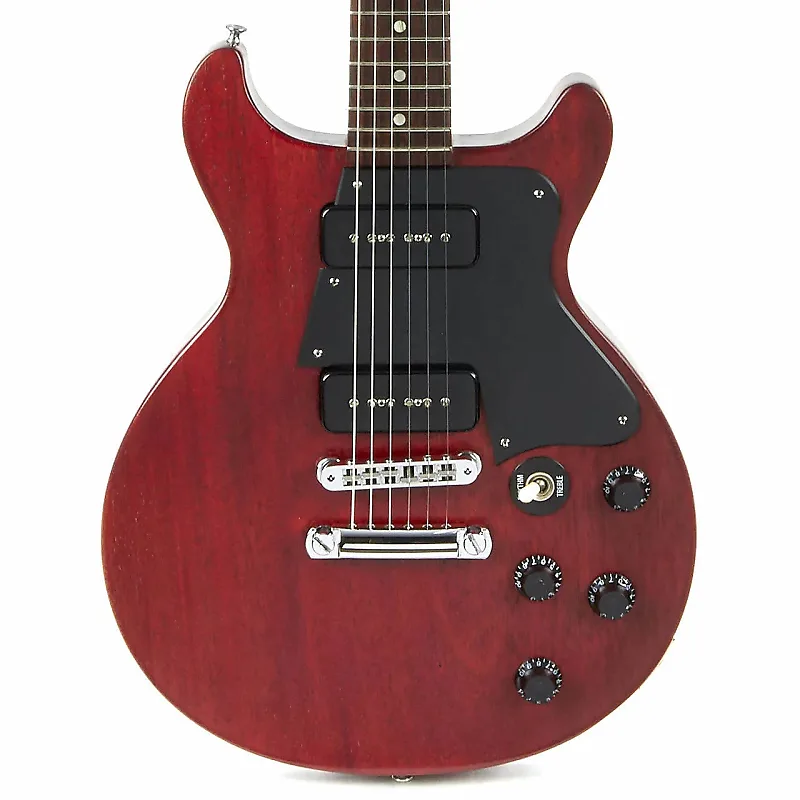
Several Fernandes guitar models have passed through my hands, and although this one is simpler in terms of electronics, since it doesn't come with the famous "sustainer," I dare say that, for its price, it's the guitar from this maker that I've liked the most of all the Fernandes I've tried.
The concept of the instrument is reminiscent of more conventional or legendary guitars, in contrast to some others from this company, which tend to offer "combat sounds" and spiky designs. A Strat-style shape, always with Fernandes' sharper and more aggressive touch, combined with a bold finish, as you can see in the photos.
Unboxing
When I took the guitar out of its gig bag, I quickly associated the product with its brand because of the aggressive finish and hard-rocking look, despite the conventional body design. Good attention to detail and the initial look of a bold guitar within classic lines.
As for its construction materials, bear in mind that for 300 euros (approx.) you wouldn't expect a maple body, so I think the quality level of its woods is fair.
The surprises begin: its sound and pickups
When I plugged the guitar into the amp, I went straight for hard-rocking sounds; that is, my first tests were with distortion, since with other instruments from this company I'd had the impression that this was where they did best.  At that point I started to notice something I liked: harmonics came out very easily with distortion. Maybe it had something to do with the fact that I'd been playing a Gibson Les Paul just before, with a darker, thicker sound. Hearing that sharp single-coil brightness on the Fernandes and, consequently, the wide range of nuances depending on pick position and intensity, I had a great time, and it awakened my creativity and my craving for saturated adrenaline.
I thought most of my sound tests were done and, well, the result was satisfactory considering the price, but... of course I had to try the instrument in other tones and roles, so I decided to switch to a "vintage" sound, fairly thick but with treble and much more moderate saturation. First surprise: the guitar sounds very good in this setting. I went through the five positions of the selector, moving between the combinations of the two single coils and the powerful humbucker, with surprising results. In this part of the tests, I liked the guitar even more. The thick, punchy sounds of the dual-coil pickup (humbucker) are very interesting for heavy, round passages, but sometimes you miss the brightness and percussive emphasis (which I love so much in many Ibanez guitars) of single-coil pickups. So the two-single/humbucker combination strikes me as one of the smartest standard configurations in the electronics repertoire. After a good while playing pieces, I also found some "Fender inspiration." I mean that legendary Stratocaster flavor, leading me to conclude that the range of possibilities of this Fernandes Retrorocket is, honestly, powerful and versatile.
I finished the listening tests with completely crystal-clear sounds, seasoned with chorus and delay. Once again I was completely satisfied with the result: very defined sounds, with a great quantity and quality of treble but without losing body and definition.
Feel, tuning and intonation
This is often where things fall apart; that is, the instrument has a good combination of pickups, but modest prices force the manufacturer into mediocre construction. It was in this evaluation that the Retrorocket won me over completely. The feel is smooth and the string set suits the instrument well: a fairly comfortable string height relative to the fretboard and a balanced setup. All this without fret buzz or any fret on the fingerboard making "weird" sounds.
I put the tuning to the test, playing for a good while, even with a slide or various types of phrases that included sharp bends, use of the floating bridge (vibrato), etc... In other words, the string tension was pushed to the limits of tuning stability. The response was average, though fair for its price.
Apart from the construction, the neck/body joint, wood quality and drying process, the truss rod installation and quality, etc., the hardware has a lot to do with tuning/intonation, since a bad bridge (especially a floating one) is prone to going out of adjustment, and a poor set of tuners invites detuning and imprecise adjustments. That said, I should mention that, without great luxuries or excesses, the guitar on our bench has an effective and manageable floating bridge, as well as Gotoh tuners. All of it finished in black.
Conclusions
An instrument without frills or "flashy complications," but one that does what an electric guitar should do: sound good and stay in tune, which for my taste is the most valuable thing. As an interesting aside, I should tell you that when I was testing the guitar, I still hadn't looked at its spec sheet or retail price, thinking it would be above others in its range. As you'll have seen after reading this review, this guitar really does have its charms.
When I finished testing, I thought a reasonable price would be practically double what it costs. My last surprise came when I found out that it cost only €308 (approx.), leading me to conclude that the Fernandes Retrorocket X is an option well worth considering, even compared with other purchase options (from different brands) up to €600.