Since Fender was enjoying great success with its solid-body electric guitars in the early '50s, Gibson decided to venture into new concepts in collaboration with Lester William Polfus (Les Paul), a guitarist and inventor whose creations have had a decisive influence on the development of the modern electric guitar.
The result was a Gibson bearing its creator's name: the Gibson Les Paul, characterized by its carved top and symmetrical headstock. The Les Paul was a first attempt at creating a modern solid-body guitar and, as you all know, its design has remained unchanged throughout its forty-plus years of existence.
In 1958 the Les Paul Standard appeared, replacing the Gold Top; the basic difference was the sunburst finish, in an attempt to give it a more "traditional" look. Later, in '61, the SG line appeared, along with another series of developments (in different years) and variants on the original models, as part of the company's effort to innovate from the moment the first prototype appeared. We could write a book given the range and variety of models, but for today we'll leave it here as an introduction.
Our test bench
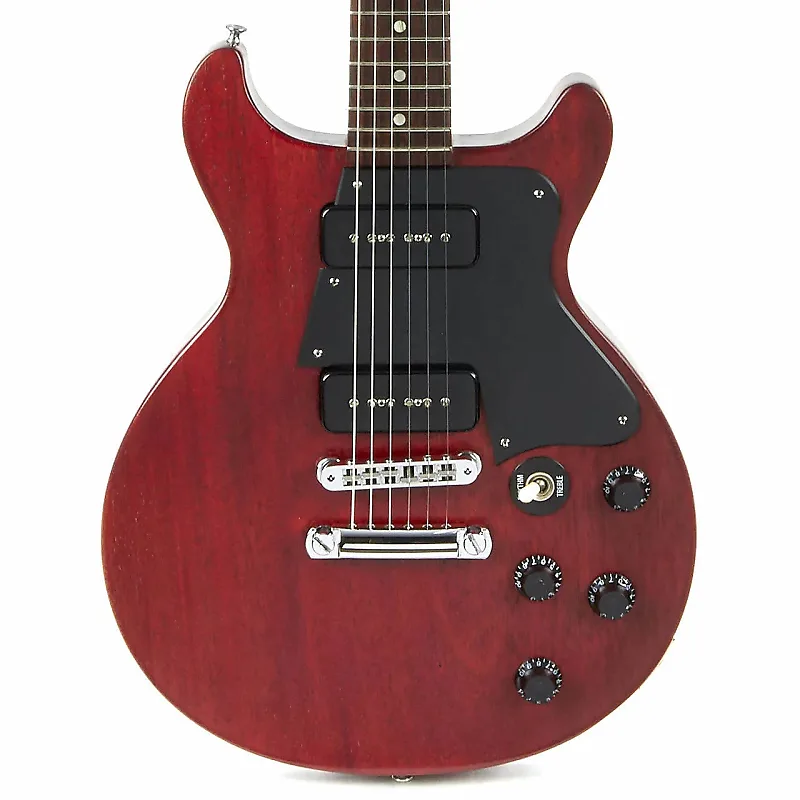
We were eager to dig deep into a Les Paul again. This time, a 2004 double-cutaway Les Paul Model, made in the USA, from the FADED series, characterized by its P90s and a worn-looking finish that gives it a touch of the legendary Gibson. Its P90 pickups also stand out, with a less "thick" and dark tone than the PAF humbuckers fitted to its predecessors.
As for looks and body, the truth is that I felt "right at home": a classic guitar, somewhat sharper-looking thanks to its double cutaway, but keeping that traditional touch, which I personally like.
It is a light instrument, considerably lighter than its first cousins, well finished and with the unmistakable Gibson stamp. The materials used are of good quality and the final finishing is perfect, even with that "worn" look. Judging by the look, it seems like you've picked up a collectible Les Paul somewhere, one with plenty of mileage behind it, and it's a nice feeling.
Pickups, electronics and sound
P-90 Vintage Single Coils
P-90s are pickups that have always left musicians with a good taste in their mouths. They are characterized by a thick, high-output vintage sound. They give off a more nuanced and brighter sound than PAFs, which makes the guitar versatile. On the downside, it must be said that the pickup is a little noisier if you overdrive it with heavy distortion. I don't think that is the ultimate purpose of these pickups, although it is a guitar that generally responds well in very diverse contexts.
Today's instrument faced a tough exam, since the examiner has always shown a fondness for the Strat sound. Well, today I have finally concluded, though I had already sketched out the idea before, that you can't weigh them up to choose one, and that the best option is undoubtedly to own a guitar from each company, because the instrument in my hands has an absolute "something" that gives it its own personality and a Gibson flavor that every guitarist should undoubtedly have as a tool throughout his or her career.
It is one of those guitars that speaks to you, that invites you to play, and that you enjoy 100% because it gives your playing such punch. I sincerely enjoyed this test. You have a three-way selector that lets you choose bridge pickup, neck pickup or both, which you can fine-tune with two independent volume controls and two tone controls.
What I liked most is its punch, the thick, round sound it produces, but at the same time with a bright layer that gives it definition and good attack (perhaps the single coils have something to do with it). First, I turned on the rig when I plugged in the guitar, and a totally bluesy vintage setting was selected. I spent a good while playing and stopped feeling like I was "testing" and started "enjoying." I was pleasantly surprised by the instrument's sound, and before adding any distortion, the guitar and I had already become "good friends."
Then I plugged in some adrenaline (via distortion) and liked it even more. You feel powerful with such a forceful instrument, with a "fat" yet piercing sound. So I have to admit that this was one of those moments when my job testing guitars rewarded me with the satisfaction of having a blast.
Tuning, bridge
The second area in which an instrument has to behave like a "champion" is tuning stability and good intonation. Obviously, without that, the sounds are of little use. Having a fixed bridge (Gibson Tune-O-Matic) predisposes us to tuning that is less prone to change than with a floating bridge, above all because we will be less "brutal" with string tension and spare ourselves the "hassles" of springs, etc. Even so, there are instruments that are impossible to keep in tune for more than 4 minutes, which drives me crazy, for various reasons, such as saddles that snag the string, tight nuts that pinch the strings and don't let them move (bends that then don't return the string to its original pitch), imprecise tuners, poorly dried woods that "move," and so on. In today's case, the guitar shows a satisfying balance and good intonation, and gives us that peace of mind that lets you relax about tuning on stage.
I put this Les Paul through rough treatment in terms of tension, with especially demanding string bends for the tuning test. Result: no problems; the instrument remained intact and ready to start again without having to touch up the tuning one bit.
Conclusions
Speaking of the extremes of sound and the roots of the electric guitar families, I began this test talking about the difficulty of weighing up the two guitars that have been competing since their birth: Stratocaster vs. Les Paul, concluding that the ideal thing (I'm sure many of you will agree with me) is to have one of each (or similar options). For many of us this is difficult, and the question arises: is it better to have two mid-level legendary guitars or one of the two in its most powerful version? I think the answer depends, logically, on each person's purchasing power, combined with how clear you are about your sound and how much you identify with each of them. In other words, if you work in open musical fields and play various styles, as you "refine" and become meticulous about your sounds, you will probably find yourself craving several guitars. Then again, you may have enough versatility with just one, within a somewhat smaller range of action.
All these reflections come before the conclusion about the versatility of this instrument. I found in it the density and "thickness" characteristic of a Gibson Les Paul, but also enough cutting flashes to tackle things for which on other occasions I would have chosen a Strat, or something else (although they are very different guitars). So, if you don't have the resources to own both (or 15 different ones...), I think this instrument has the perfect bite for thick distortions and enough bluesy verve to play with attack and piercing tonal colors.
I'll finish by considering two more points about the Gibson Les Paul Faded Double Cutaway. On the one hand, the price, at the time of release and of writing this test (2004), seems quite reasonable to me for a genuine USA Gibson made from select materials. From my point of view, the money will be well invested and the guitar delivers what it costs.
The other aspect, always looking for the weakest point in each test, is the feel of the strings: correct, with a pleasant sensitivity, but I would have preferred it a little "faster," with slightly lower action. As you all know, bridges allow adjustment over a fairly wide range to better suit each guitarist. On top of that there are possible variations in the type and gauge of strings selected, seeking a balance between body (from the gauge), brightness, stiffness and playing comfort. If you can't have several instruments, each set up for the context in which you will use it, the optimal setup for a single guitar is a middle ground between a "soft" guitar with no fret buzz and one with enough heft and solidity. It depends on style and personal taste, though. In this case, and since the guitar (to my regret) was only visiting, I preferred to leave it as it was, although I would have adjusted it a little to make it fit like a glove.

