Snoop Dogg’s Beach City Music has long been a model of creativity on the West Coast. After opening three new studios, with the mothership as the main attraction, the people responsible for the upgrade tell us how the new facility looks. Just five minutes from Los Angeles International Airport stands a 20,000-square-foot building that serves as the headquarters of one of the most important names in hip hop.
The Snoop Dogg’s Beach City Music complex is more than a studio, and its owner is more than a musician. Surrounded by his collection of vintage and modern cars, alongside a basketball court, a game room, a radio broadcast studio and a video editing suite, it is the pinnacle of Snoop Dogg’s business and a hotbed of culture and creativity for today’s artists.
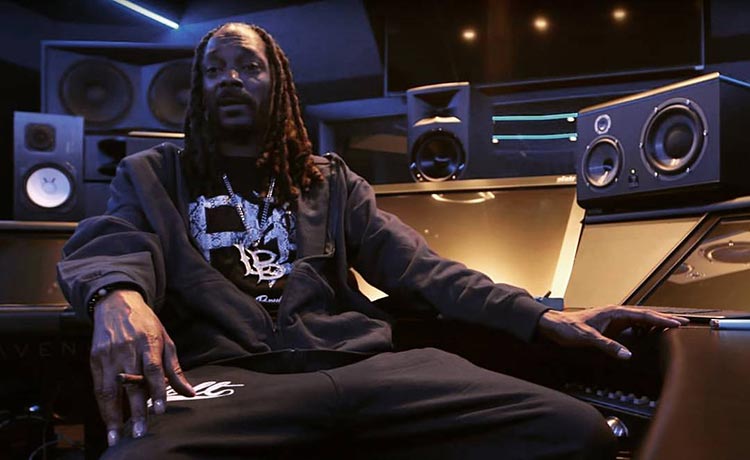
The facility, called The Compound, is housed within a complex made up of a trio of futuristic, flexible studios that simulate the experience of being inside a spaceship. Snoop’s right-hand man, DJ Pooh, was key in the decision to include in Studio A (the mothership) the AMS Neve Genesys Black console, integrated with a Slate Raven MTi2 in a custom Zaor desk. “The console is great. Snoop could have picked any console, but the Genesys Black has everything we were looking for,” says DJ Pooh about acquiring the console.
Most of the work done at Beach City combines music produced with sequencers, drums and keyboards with live instruments. Snoop and his team needed a console that could switch quickly and easily from one track to another. After a lot of thought about which console would best fit their needs, Professional Audio Design came up with the Genesys Black. The company’s president, Dave Malekpour, says the console is “a great solution that combines the sound of a vintage Neve 1073 transformer and a Class A 1084. This combination lets Beach City’s producers and their clients take on different projects and tracks and add classic sounds to their recordings.”
The Zaor desk not only houses the console, it is a workstation that lets producers plug into the central system, giving them the ability to work with their own material until it is ready to be processed on the Genesys Black. “We ended up designing all the studio furniture for the mothership, keeping the same aesthetic throughout the place,” explains Malekpour. “The whole design is very ‘sci-fi’.”
However, the console chosen for this first studio is just one element of a much larger installation that includes Studio B (the battleship) and Studio C (the spaceship), as well as other smaller recording rooms. Sales consultant Chris Young and technology director Jonathan Deans of Westlake Pro worked very closely with Snoop and DJ Pooh on the design, wiring and equipment integration for this project.
“At a time when studios aren’t having their best moment but are disappearing, it was a lot of fun to help build a facility this big dedicated to music,” explains Young. “When they first consulted us they were simply looking for someone to do the wiring, but we ended up helping with practically everything,” he continues; “we collaborated on every detail. We came into the project in February 2015 and the installation wasn’t finished until November, so we had to wait quite a while to get our hands dirty. It was all quite different from what we usually do, since you were working with Snoop’s project managers and we normally work directly with the client.”
The mothership uses a Pro Tools HDX rig with 32 analog inputs and outputs and 64 MADI, all safely tucked away in a machine room outside the studio. The 7.1 surround system features a Focal SM9 in tandem on the left and right with JBL LSR 708 and 705 speakers, along with a new JBL Sub18 for the LFE channel. In addition, the Westlake Pro team predicted that Snoop and DJ Pooh would need extremely low frequencies for playback, so they included a Crown Audio IT12000HD speaker channel. “Studio A also includes new and vintage gear, such as a Pultec EQ, an LA2A, two 1177s, two Distressors, an Avalon 737 and a Tube Tech CL1B,” explains Young. “There was a lot of cable involved,” he jokes.
Studio B, meanwhile, features another Zaor desk with a Slate Raven Z3 touchscreen production console with 5.1 speakers and the same components as the mothership. However, this companion studio has less analog gear, though it uses a Pro Tools HDX system with 32 analog inputs and outputs and Focal SM9 monitors.
Professional Audio Design ended up supplying all the custom furniture, equipment and wiring for Studio C, a writing and tracking room created especially for Snoop’s son, Cordell. In addition, to meet all of the studio’s needs, Malekpour built an Augspurger system, the largest to date, with a Quattro 415 system, a pair of Solo 12MF monitors and a Slate Raven MTi2. “Snoop and DJ Pooh were very impressed with the sound it delivers when working with the Genesys Black,” he explains.
Malekpour managed to tune the Augspurger DSP to produce an accurate, consistent mix curve in all the rooms. This is one of the reasons the studios have been so successful since opening: “when you get three rooms of different sizes and with different functions working together, you get something very special. I think it’s the signature of Beach City Music,” he confesses. “The collaboration between different things is a reflection of what Snoop does in his work.”
Malekpour closes with a reflection: “Snoop has an incredible vision, and helping him create studios like these has been a great opportunity and an impressive job.”