 The fourth season of the televised music talent contest La Voz recently came to a close. Over several weeks, dozens of contestants appeared on the show to prove their worth as singers. Several established artists also appeared during the run to support the participants and set an example for them. An interview with Víctor Ondaro, the show's head of engineering, to give us a firsthand look at the details of the project
The audiovisual infrastructure needed for a spectacle like La Voz was on a massive scale, and its design and subsequent operation were handled by the company SBA Radical Sound, which selected specific Shure and Soundcraft equipment. Earpro had the opportunity to interview Víctor Ondaro, its head of engineering, to give us a firsthand look at the details of the project.
What technical needs did you face when you started tackling the sound reinforcement and broadcast of La Voz?
La Voz: When we at SBA Radical Sound began designing La Voz IV, we faced the challenge of dealing with two sound disciplines that normally go their separate ways: live music and television broadcasts. So the need we faced was to convey the energy of a live performance while attending at the same time to every detail of a demanding broadcast. For that we needed a team of top-level professionals, a detailed study of each technical position, and versatile, reliable systems that would ensure our success in all the sound reinforcement situations we would face over the course of the contest's stages.
Q: Could you please describe the technical solution you designed?
VO: We had three set control rooms and one broadcast mobile unit. Each of these control rooms had a different approach to the sound and different needs. As for connections, we had a patch that centralized 150 split channels, discrete recording of those channels, 45 monitor sends, 90 instrument channels played by 13 musicians, plus the voices of the contestants and guests. As for wireless transmissions, we had 160 frequencies of our own for the show across mics, in-ears, ENG and comms.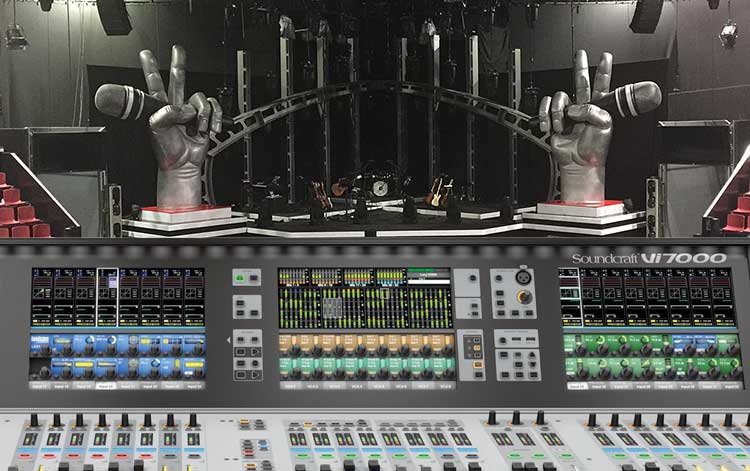
Q: What Shure and Soundcraft equipment was part of this solution, and what results did you get with it?
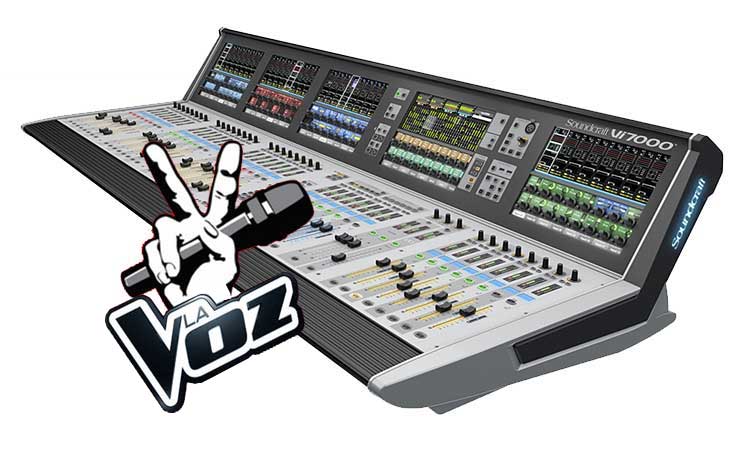
VO: After weighing the different technical solutions the market offered us, for the control rooms we opted for Soundcraft's new Vi Series. We used two Soundcraft Vi7000s and one Vi5000. The core of the communications between control rooms was in the Local Rack with Studer technology, which gave us a broadcast-grade solution for signal processing and, above all, for communications between control rooms. MADI over Cat5 cable gave us a stable, versatile protocol, which we used for the main signal infrastructure. It's also worth highlighting the ability to communicate via DANTE, a protocol that has become a standard in the audio industry.
 The control surfaces with Vistonics technology deliver a quick learning curve and fluid handling of the consoles, essential for a service company like SBA and for the demands of doing a live show. This way, we were able to focus on the individual treatment of each of the channels we worked with, taking into account whether we were on the PA, on monitors, etc. The large number and high quality of plug-ins and the RealTime Rack were an indispensable help for this processing and for delivering optimal technical solutions to the artists who came through the contest.
For microphones, SBA Radical Sound used, as usual, Shure's top-of-the-line ranges. The ruggedness of the systems, together with the superb management provided by the Workbench 6 software, gave us the peace of mind we needed for the transmissions, with 70 transmitters of the UHF-R system (35 UR1 units and 35 UR2 units with SM58 and KSM9 capsules) and 16 transmitters from the ULXD digital series. To get the greatest reliability in live shows, and to be able to concentrate our efforts on other areas, systems from the excellent AXIENT series were added.
The bulk of the in-ear monitoring fell to the PSM 1000 series, for guest artists and coaches. Thanks to their diversity reception and the warmth of the audio, they made sure the artists felt comfortable at all times. The contestants used the PSM 900 series, along with Shure SE215 in-ear earphones, and were impressed to notice a quality well above the usual.
The presence of Shure and Soundcraft on La Voz is a good indication of the reputation, reliability, quality and long experience of both brands' systems in projects of this kind and scale.