 [Pointing to a Marshall amplifier] “This is a head we use on stage… the numbers all go to eleven, right across the board. Most blokes are playing at ten, but… where can you go from there? If we need that extra push over the cliff, we put it up to eleven. One louder." (Nigel Tufnel, Spinal Tap guitarist)
The guitar amplifier is a tricky instrument. I say “instrument” because good guitarists can make amps sing. There’s nothing like a well-dialed amp plugged into by a good guitarist. If you’re like the rest of us, your amp only goes up to 10. So if you want it to sound louder (or one louder), here are some tips to help you capture that sound.
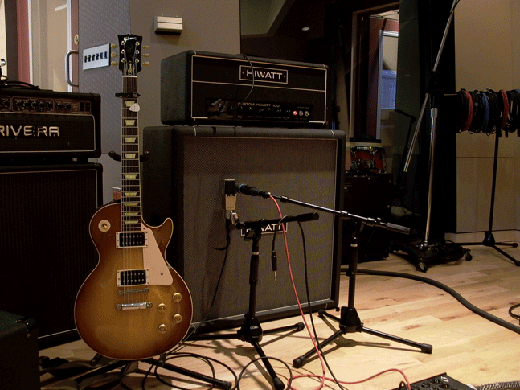
The best advice for single-mic recording is to place the mic right on the line between the dust cap and the speaker cone. This will give you a well-balanced sound that works great in every case, from clean tones to distortion. The more you move the mic toward the center of the speaker, the brighter it will sound. On the other hand, the more you move it toward the outside of the speaker, the thinner it will sound. If you have a player whose amp sounds thin or very bright, try moving the mic toward the outer ring of the cone to tame those highs.
What I like to do most is record with two microphones. I use a KSM27 condenser microphone (a model that is discontinued today and has been replaced by the SM27 condenser model) and place it 3 to 5 cm from the speaker’s dust cap, on the line where it meets the cone. This gets a good overall sound. Next, I place a Beta 56A on the other speaker, right on the line. Both mics end up about 2 cm from the amp’s cloth or grille. I blend these two mics, more or less like a two-band equalizer, to get a single amp sound.
This trick is handy from song to song, thinking of one fader as a bass control and the other as a treble control. Instead of fiddling with the channel EQ to make the guitar sit in its place, try varying the blend of these two channels. If you like a challenge and want to make it more complex, place a mic at the back of the amp. This spot has a very dull sound, but with a lot of body. So it really needs to be complemented by a microphone at the front to retain detail. Don’t forget to flip the polarity (the button that looks like a zero with a line through it) of the rear mic. Otherwise, you will have serious phase problems. This is another way to get a good sound, and it can add a lot of body to an amp that lacks it.
About John Mills: John is a 20-year veteran of the live sound world. In addition to his concert work, John is Vice President of Audio at Nashville’s Morris Light & Sound. He has been a regular contributor to Shure Notes, as well as a speaker at various pro audio seminars in the United States.