
The 6 Fire 24/96 is now the DMX 6Fire USB: a compact format with 4 inputs and 6 outputs over USB 2.0. That's how TERRATEC announced the relaunch of this already classic interface, now under the name DMX 6 Fire USB. It succeeds the DMX 6Fire 24/96. After a revision and fine-tuning, the idea is to offer musicians and DJs a more capable device with more features and better performance, now reaching 24-bit/192 kHz (versus 96 kHz on its predecessor).
From PCI to USB 2.0.
Among the key changes is the move from the PCI format (an internal card) to an external unit with a USB 2.0 connection. While they were at it, they could have swapped USB 2.0 for FireWire. Given the real power of this interface, with its four inputs and six outputs, I think FireWire would have been a better and more current solution. Still, USB 2.0 is a perfectly valid solution, and it works.
How the Manufacturer Describes Its New Product
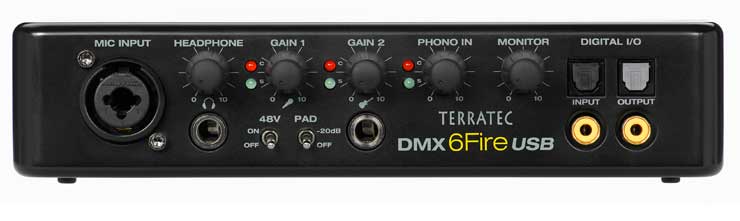
Designed for the consumer electronics market, this interface may also surprise those with a small home studio, thanks to its four analog inputs and six analog outputs in RCA format, plus digital inputs and outputs (optical and coaxial). Its new configuration delivers high-fidelity audio and a 100 dB signal-to-noise ratio. It also has a mic input (XLR/combo jack) with 48V phantom power, a -20dB pad switch and a gain knob, as well as an adjustable input for instruments such as guitars or basses. All these features allow the DMX 6 Fire USB to make recordings at the highest professional quality. Through hardware monitoring, input signals can be routed straight to the output and heard with no latency. The icing on the cake is its MIDI interface and headphone output. DJs get what they need just by plugging their player (turntable) into the phono input (with preamp). The monitor controls let DJs preview tracks before spinning them. The mic inputs (1/4" jack or XLR, with a mini-jack adapter) and the headphone output sit side by side. The DMX 6 Fire USB also features a 5.1 surround sound system and converts mono sound inputs to stereo.
TERRATEC on the ISP Música Test Bench
Running on Windows Vista
We installed the unit on a PC to put it through our usual tests. One thing we liked is the included driver update for Windows Vista. Although many users still run XP, it's frankly regrettable that products are still being sold without Vista drivers since, presumably, that's the natural trend for any PC user.
Although its manufacturer launches this product as a "consumer" device, meaning for all multimedia users, the reality is that it is, in fact, a good tool for anyone building or upgrading a home studio. It even outperforms many of the small devices on the market, though it also costs more (than the entry-level interfaces you can find).
Midrange
This interface could be placed in the midrange because it offers four simultaneous inputs and six outputs. It also provides phantom power, gain and monitor controls, a multi-input format (XLR, jack), an improved sample rate, MIDI connections, digital outputs, and so on.
You could say there are far cheaper models to start with, with two inputs, two outputs (that is, one stereo pair) and everything needed for the basic tasks of a home studio. These units are usually priced under €80 and give you the bare essentials to get started.
At the other extreme, at the top, we find professional or semi-pro formats: rackmount interfaces with eight or more inputs, quality preamps, various monitoring paths, control surfaces/motorized interfaces, and a long list of other features. In this range prices run between €600 and €2,500. Their main advantages are a greater number of simultaneous inputs and, above all, the quality of the preamps. Obviously, control surfaces/interfaces have (depending on the case) added perks.
So we can say that a four-in, six-out product that costs around €300 sits on the middle rung.
From users' experience, I know that Terratec is a brand that has left a satisfactory mark so far. Even so, depending on the production software you plan to use, for this price you could land on a variety of equally reliable options such as M-Audio, Digidesign, Edirol, PreSonus, and so on. It's all a matter of comparing (at the same price) inputs, outputs, zero-latency guarantee, preamps and overall features.
What's in the Box and Test Results
We installed the device without any problem and it works correctly, with no latency. Its input/output setup works properly and the whole range of functions does its job with ease. The blending of MIDI and audio under this interface's control works correctly.
Inside the Box You'll Find
1. Power adapter.
2. Two mini-jack to 1/4" jack converters (one mono and one stereo).
3. Cable connecting the interface to the USB port.
4. Interface.
5. Installation disc.
6. Installation manual (Spanish version included).
Front Panel
a) Combo input accepting TRS 1/4" (1/4" jack) and XLR (for mic).
b) Headphone output.
c) Headphone volume knob.
d) 4 knobs: gain 1, gain 2, phono input and monitor control.
e) Digital output and input.
f) RCA output/input.
g) Off / -20dB switch.
h) 48 V phantom power switch.
Rear Panel
a) Power input.
b) USB connection.
c) MIDI IN.
d) MIDI OUT.
e) RCA input and output panel.
Conclusions
I was surprised to read that the interface was meant for the general public. Perhaps its readiness to play around with 5.1 surround sound is what brings it closer to the mass market. Although I'm sure the "masses" will enjoy this interface for their multimedia applications, I find it somewhat excessive for an outsider with no ties to music. Why would someone with no interest in recording want phantom power?
On the other hand, I find a collection of features that make it very capable of comfortably covering all the basic needs. It lets you connect your creativity (guitars, keyboards, turntables, MP3 devices, drum machines, modules, and so on) to the central unit (the computer) and the right music software (Cubase, Cakewalk, etc.). The device shows details that make it quite specific to digital production applications. We liked the details: the multifunction input, the individual gain control, the headphone control and the other level knobs.
The pad and phantom power for condenser mics also point to a semi-advanced design. The only oddity is that the update of the DMX 6 Fire 24/96 stuck with USB 2.0 instead of FireWire. As for the price, it's not bad for four inputs and six outputs.
It has everything you might need in a midrange interface. As the famous suited man on TV used to say: look, search, compare, and if you find something better, buy it.


