
From its product catalog, British company Prism Sound offers us the Orpheus, a FireWire interface capable of handling eight channels of both input and output, which I've had the immense pleasure of testing and whose most outstanding features (in fact, literally all of them are, and I mean that) I'll try to break down and discuss for all of you, our friends and followers at ISP Música.
I can state without any doubt whatsoever that this time we're getting up close with what is, in principle, a high-quality, one-hundred-percent professional eight-channel (FireWire) external sound card. So much so that I recommend it for recording studios, and beyond that, for mastering studios. Not for nothing does Prism Sound have a number of machines in its catalog designed precisely for mastering, which amounts to cutting-edge technology and, consequently, rigorous precision (within the current state of the art, of course). I trust you're all getting the picture.
About its importer in Spain
The real news, as far as we're concerned, is that this Prism Sound product is finally distributed here thanks to Makermid S.L., a company that started out in 1995 and is based in the "Ciudad Condal" (Barcelona, if you prefer). These good people handle both the distribution of products, most of them absolutely top-flight, and their direct sale. To give you a clear idea of what I'm saying, Makermid is the distributor/seller in this country of products such as AVALON's, among a good handful of other designers and manufacturers of, I insist, the highest quality. So one could easily imagine the existence of a universe, a mix of pro audio and high-end, part of which, as you now know, is located at Makermid.
Orpheus, object of desire
The Orpheus is a multichannel (8 in/out) FireWire 400 (IEEE 1394A) sound card, suited to personal recording and audio productions, for professional musicians, composers, producers, recording and/or mixing engineers, multitrack recording/playback, mastering and, in short, every application required in the most professional field of audio. This gem works on both Windows PC and Mac platforms. All the software needed to configure and use it is on a disc included in the package, which also contains the instruction manual (in English) in PDF, although we also get a printed copy; and naturally the appropriate power cable + 2 FireWire cables + a pair of adapter cables, with which we can get an AES/EBU connection from the Orpheus's coaxial digital input/output. It also includes a pair of brackets for rack-mounting it; it takes up one rack unit in height, although it's advisable to leave another unit of free space above it for proper cooling.
During software installation, it's essential to have the Orpheus unit connected, via FireWire of course, so that the DAW recognizes it and the installation process can be completed. Otherwise, I didn't have any problems; I installed the software on the disc just like any other application. I'd naturally recommend that potential users of this little gem take a look at the manual. But above all, install the software quickly without any fear, because once you see the various control panels on your PC monitor, how the Orpheus works becomes very obvious. I assure you it's truly intuitive, although at first glance the manual may cause some apprehension among people not well versed in digital audio.
Prism Sound's Orpheus in broad strokes
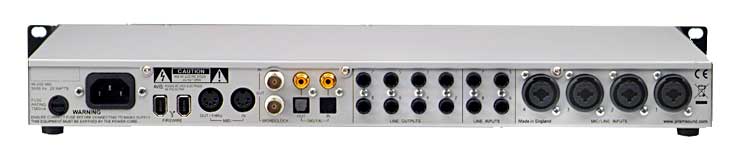
- Two unbalanced high-impedance (1 Mohm) inputs for direct connection of instruments such as guitar, bass, etc.
- Four electronically balanced mic/line inputs (XLR/TRS jack combo connectors). The mic inputs offer individual phantom power (48 volts).
- Four balanced line inputs (TRS jack), with level selectable between +4dB and/or –10dBu.
- Neutrik connectors.
- Progressive dynamic limiting on all eight inputs: OVK (Overkiller), a proprietary Prism Sound circuit.
- High-quality two-channel sample rate converter (SRC) on the S/PDIF inputs/outputs (assignable to the inputs or the outputs, but the SRC cannot be configured for both at once), with frequencies from 44.1 kHz to 192 kHz.
- MIDI in/out.
- Extensive sync options, with a superclock option at 256x the sample rate.
- Prism Sound SNS (Super Noise Shaping), configurable or selectable among four different levels (the manufacturer recommends using the second level, SNS2, at least as a starting point). SNS is recognized as a standard of excellence.
- Digital in/out connections, both electrical S/PDIF and optical TOSLINK, which can accept eight input channels in the more than common ADAT format at sample rates from 44.1 kHz to 48 kHz, or four inputs in ADAT S/MUX at 48 kHz or 96 kHz sample rates.
- Up to six units (which could mean 24 mic inputs + 24 line inputs and 48 output channels to mixes) can be connected or chained together.
- Maximum sample rate 192 kHz.
- Can work independently (without a FireWire connection) in stand-alone operation
- Dual headphone outputs with dedicated independent level (mix) controls.
...And a thousand and one other things that would take far too long to mention, let alone discuss.
One curious feature of this gem is that you can connect a turntable to it, since it can apply the phono correction curve (RIAA decoding), so if need be we can digitize our vinyl records easily and accurately. For this, the instrument inputs are recommended, due to their high impedance and wide gain range.
And above all, the Orpheus's AD/DA converters (which are the key part of any digital machine; if they're weak, you might as well pack up and go home) are impressive; the unit's technical specifications speak for themselves.
The front panel
On the Orpheus front panel we find, on the left, the two high-impedance (Hi-Z) inputs for connecting instruments and/or, as I mentioned, phono. Next comes the metering panel for the eight analog inputs/outputs (selectable) and the unit's status indicators. Inputs 1 to 4 switch over automatically when you make a connection to any of them (mic or line), with a visual indication confirming it. For front inputs 1 and 2 there's also a handy indicator showing whether we've plugged in the corresponding jack (our instrument/s). A couple more meter bars also show the level of the S/PDIF digital inputs/outputs.
In the usual (or rather advisable) case where we activate the input overload protection circuit, that is, the sophisticated Overkiller progressive dynamic limiter, we'll see it working (just below each level bar) on the same metering panel, as long as the panel is displaying input levels.
The Overkiller, present on all eight input channels and switchable at will, offers instant progressive limiting of signal peaks, thus protecting the A/D converters against possible overloads; with a range of up to 10 dB, it can be applied to any analog input. This preventive circuit is undoubtedly one of the strong points of the Orpheus, or perhaps I should say of Prism Sound.
To the right of the control and metering display there's a level control wheel surrounded by a ring of LEDs (in the purest style of many digital consoles) indicating its position. This level knob mainly serves for monitoring or calibrating the level of the stereo-paired and/or surround outputs (all assignable from the control panel); it can also be used, where applicable, to control the level of the S/PDIF electrical digital outputs.
The Orpheus can work in stand-alone mode, meaning that once its operation has been configured for that situation, we can use it without it needing to be connected to the PC; in other words, it can be completely autonomous.
A pair of headphone outputs with independent level controls are also provided on this front panel. And finally, there's a button for switching the unit to standby, essential when we want to run the Orpheus in the stand-alone mode mentioned above.


