
A delight from SSL is hitting the market, putting the power and quality of its mixing consoles within reach of "mere mortals." We enthusiastically welcome the latest studio product, the SSL SIX: a high-quality, compact desk for working in the studio, in post-production, on stage or in the very current world of streaming and podcasting.
As its name suggests, it is a compact six-channel mixer, but fully featured and, as the brand implies, packed with many clever features beneath its seemingly simple chassis.
Why did SSL develop this format?
They believe this is an area of the market lacking a "better quality" option. They looked at many other compact analog mixers and felt that they all lacked "better quality," basically for these reasons:
- Many of them have level variation between channels; if you set 2 channels to 0dB on the faders, there can be a 5dB level difference between them.
- Cheaper mixers do not always pan the left/right signal correctly and can have a variation of up to 3 dB between channels.
- They are unbalanced and can have problems with noise and crosstalk between channels.
- Small faders or rotary pots make it difficult to set volume levels precisely.
Compact but highly professional
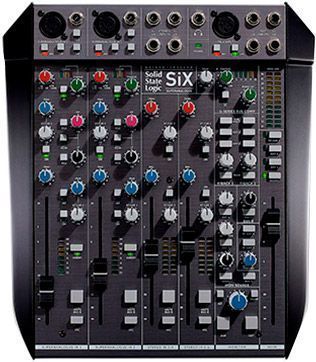
The mixer has two mono channels with SSL "SuperAnalogue" preamps; these are transparent, fast and, most importantly, have a much wider available gain range than ordinary desktop mixers usually have: 66 dB of gain! They have phantom power, a 75 Hz high-pass filter and also a separate line-level input, which can be switched to high-impedance instrument level.
Following the signal path, we have a one-knob compression circuit. This is a new feedback circuit design with a program-dependent attack time and a fixed release time. A fixed 4:1 ratio was chosen, since this value is very commonly used on larger consoles. You simply set the threshold level and watch the meter flicker to see how much compression is being applied, leaving the circuit to handle automatic makeup gain after compression.
Both mono channels have a two-band SSL EQ, which can be switched independently between Shelf and Bell curves, with different center frequencies for each type. Our design team selected these curves and frequencies as the most "musically useful" for a wide range of sources.
A good deal of time was spent working on alternative laws for the 100 mm faders, and one was chosen that provided the greatest control over the most commonly used gain range. This makes level control on stage much simpler than it would be with a rotary or 60 mm fader like those found on other compact mixers.
The unit features two stereo inputs with -10/+20 trim for line-level sources such as synthesizers, drum machines, sound card outputs, etc. These have their own balance controls. If only the left input of a stereo channel is connected (and the right is left free), the channel automatically switches to mono, panned to the center.
SSL designing a desktop mixer: powerful, right?
Although six may not sound like much, it can handle a large number of inputs in the mix. The two mono inputs and two stereo inputs give SiX its name, but it also has two external stereo inputs with volume control that can be sent to the mix bus. Including the ALT inputs, it has up to 12 channels that can be summed on the main mix bus.
The mixer is topped off with a G Series bus compressor on the main outputs. It uses the same circuit design as the legendary "SSL bus compressor" of its big sisters, but with fixed ratio, attack and release settings alongside more modern VCA chips. The simplified controls make it very easy to get that signature SSL punch and tighten up anything going through the master bus.
As with any mixer, the engineer and the artists obviously need to hear what is going on. There are two foldback buses for artists: ST CUE 1 and ST CUE 2. Each source has individual level and Pan controls for its contribution to the artist mixes. For the engineer, main monitoring is very simple, with all the controls laid out exactly where your fingers need them. The main and alternate monitors, as well as mono check, dim and cut, can be accessed directly from the front panel.
It also features a talkback mic input with phantom power and a mic compressor.
The SSL SIX is a gem for lovers of the Solid State Logic sound, with powerful processing possibilities at more affordable prices that put it within reach of a wider range of users.


