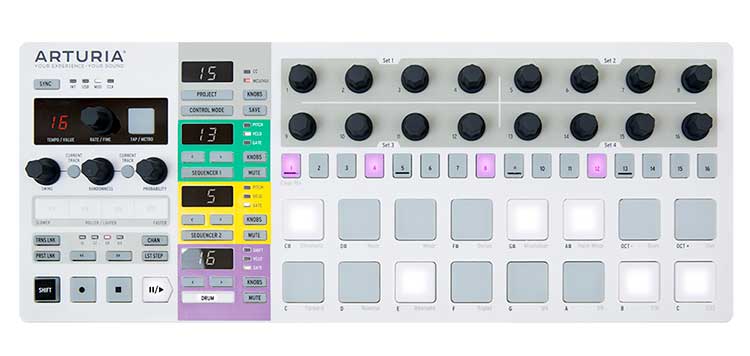
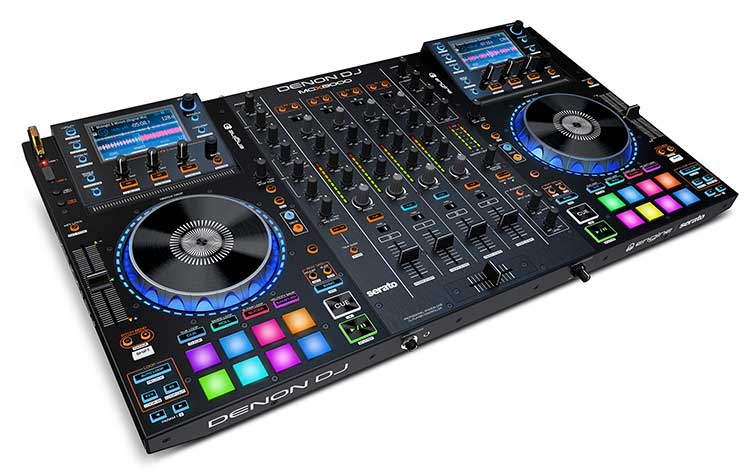
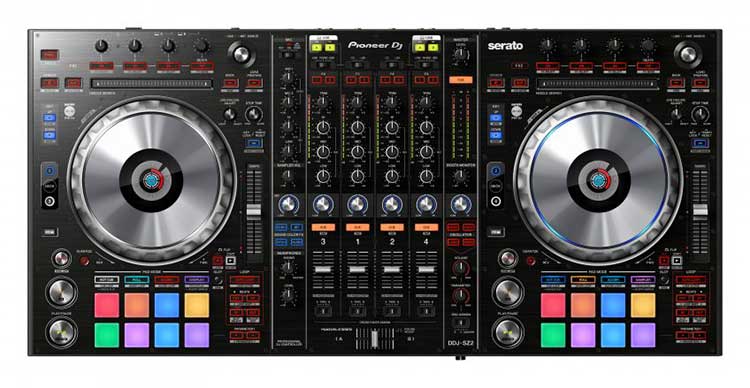
We had been wanting to tinker with a groovebox of this kind for a while to analyze its possibilities from the point of view of its target market (DJs and lovers of groove programming and electronic music). But also to find out what it brings to the studio, to the creative process, and as a way of learning a different kind of tool for, say, a guitarist or a more "vintage" musician. Let's get to it.
Who is it for?
This is a moderately priced unit compared to other options on the market. It is designed with a highly portable, easy-to-handle, very intuitive and easy-to-understand approach. You will have to fiddle around for a while (especially if you don't read the manual) to get the hang of it, although even the greatest newcomer to groovebox/pad-based technology will catch on quickly.
As I said in the introduction, it is clearly aimed at DJs with creative ambitions who are tired of using third-party patterns, as a personalized tool for the DJ booth. Obviously, the Novation Circuit is also ideal for weavers of electronic rhythms, basically with a dance vibe.
From the point of view of the musician who needs a more open tool or works creatively in a "freer" way, this little guy also has its appeal. It stimulates hidden parts of our creativity, offers another way of sequencing and is, in short, a complement that can give our classic tracks an unexpected vibe. Mixing some good guitars, a vintage acoustic drum kit and the algorithms created with the Circuit's grid can produce a fairly contemporary result.
It is certainly an excellent option for generating ideas and fast results, although it comes with enough substance to get quite a lot out of it if we put in the time and dig a little deeper: from the USB connection to a computer (Ableton Live 9 Lite included) to editing the samples and customizing the tool to best suit our approach.
Portable?
It is a completely self-contained machine, able to work without any cables at all. It runs on 6 AA batteries (or the included power adapter) and has a built-in speaker on the bottom so you can hear your work without connecting it to additional monitors. It also has, as you would expect, a headphone output. So the unit is completely self-contained and can be carried around or used anywhere without being plugged in.
These 240 x 200 x 35 mm become a more powerful unit in terms of listening once connected to the right peripherals. For this, it has MIDI in and out (for connecting to external gear, synths, software, other grooveboxes, etc.) and mono and stereo outputs on 1/4" TRS jacks for listening to our creations properly and in depth (powered monitors, PA, mixer, etc.). So once in the studio or the booth, we run a couple of cables to the monitors, mixer, interface, computer (USB), plug it into the mains, and let it rip!
What is it, what does it offer and how does it work?
When we started (quite a few years ago now) working with patterns, grooves or systems capable of quantizing and automatically placing notes in their exact position, we were blown away. The final editing possibilities through quantization, tuning, pitch correction and work with (customizable) loops have evolved spectacularly.
Suddenly, along the way, a new way of sequencing appeared: grooveboxes, quite a novelty. Desktop surfaces with PAD grids capable of entering or editing grooves (rhythmic and melodic) by bar divisions and tracks. A simple and very intuitive way to create rhythmic patterns (or melodic ones in groove mode) that combines lighting up parts of the bar and dividing it into pads so you can put each note in its place quickly. And above all, very visually.
Since then we have browsed, observed and made good use of quite a few units that work with this philosophy. The thing is that by connecting the groovebox to a keyboard via MIDI, to a computer via USB or FireWire, and to audio inputs that capture samples (on those that allow it), you can do really elaborate things.
* You can visit Zentralmedia's YouTube channel to watch quite a few episodes on how to create patterns, generate rhythms, record synths, add effects, etc., in detail.
Tracks, banks and number of bars
Several factors determine the "power" of a groovebox. I would divide them into six main blocks.
1. Tracks and pattern length. The amount of "room" the unit offers for sequencing. That is, how many different tracks we will be able to record, as well as the maximum length of a pattern. Making a repetitive two-bar groove is not the same as being able to create complex patterns of 16 or more bars that let us make "complete songs" with some creativity. This way we can use short patterns (or not) for rhythmic sequences or loops and also generate patterns of many bars that break the monotony a short loop can cause.
2. Sound banks. A broad, well-stocked catalog of libraries will give us tools. Obviously, the importance of the libraries and the acoustic quality of the samples.
3. Physical architecture of the groovebox. Comfortable, durable pads that convey information clearly and let us work intuitively, exploring its possibilities with keyboard shortcuts and well-organized views of the work areas.
4. Ability to connect with external devices. The better prepared the device is in this respect, the bigger it becomes, as with all digital tools. If a machine works as a closed or partially open system, we will exhaust its resources quickly. However, if it can be connected to synthesizers, computers and external editors, lets us sample, etc., we can keep feeding the unit without it becoming obsolete in a short time.
5. Effects and editing capability within the unit itself. Having filters, effects and a good number of pads and knobs means we can comfortably fine-tune every part of our work, "polish the nuances" and, in short, truly control our sound.
6. Polyphony. Obvious but necessary. The more notes the "gadget" can trigger simultaneously, the more powerful it will be, and the fewer creative limitations we will find.
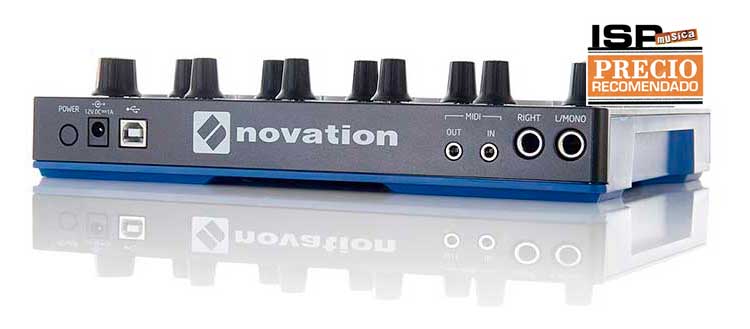
Novation Circuit features
| 32 velocity-sensitive RGB pads | 1/4" jack outputs | |||
| 28 RGB function buttons | 2 MIDI inputs and outputs | |||
| 8 RGB-lit knobs | Headphone output | |||
| Dedicated volume and filter knobs | Built-in speaker | |||
| Two-part synthesizer | USB -> computer -> others | |||
| 6-note polyphony per synthesizer | Not USB bus-powered | |||
| Sequencer | Can be powered by 6 AA batteries | |||
| Real-time recording | Dimensions: 240 x 200 x 35mm | |||
| 4-part drum machine | ||||
| Ableton Live Lite 9 included | Approx. retail price: €290 - €300 | |||
| Manufacturer: Novation | Distributor in Spain: Zentralmedia |
Conclusions
We find Novation's Circuit to be a fairly versatile tool. It can pass for a simple, quick-to-use groovebox, for example for a DJ who needs to personalize and add his or her own signature to the mixes without making life too complicated. Along the same lines, it is something intuitive and fast for someone who wants to become familiar with pattern-based sequencing with a rather electronic vibe.
However, it goes a little further. Its connectivity, the number of programmable bars per pattern, its well-designed architecture and the quality of its sounds, with deep lows and professional samples, make it a possible complementary tool for a producer or musician with electronic leanings, as a way of bringing this "vibe" into any production that is not based exclusively on this "style."
Its size, weight and complete independence (on batteries if desired), along with its own speaker, add further appeal to a device that can be used while traveling, on the street, in a park, in the studio, in the booth... anywhere. This lets you work on and develop ideas anywhere, and then integrate the Circuit into your system (monitors, PA, mixer, mains power, computer, etc.) and keep working.
At approx. €290, it is a tempting option compared to its competitors.