
You tune the open strings, the guitar sounds perfect, and yet as soon as you move up the neck something grates: the barre chord at the seventh fret sounds sour, solos high up drift out of tune and the tuner insists everything is fine. The culprit is almost always the same: the intonation is off. Setting intonation is a simple adjustment any guitarist can make at home with a tuner and a screwdriver, and it makes the difference between a guitar that is "more or less" in tune and one that plays in tune all over the neck.
What setting intonation means
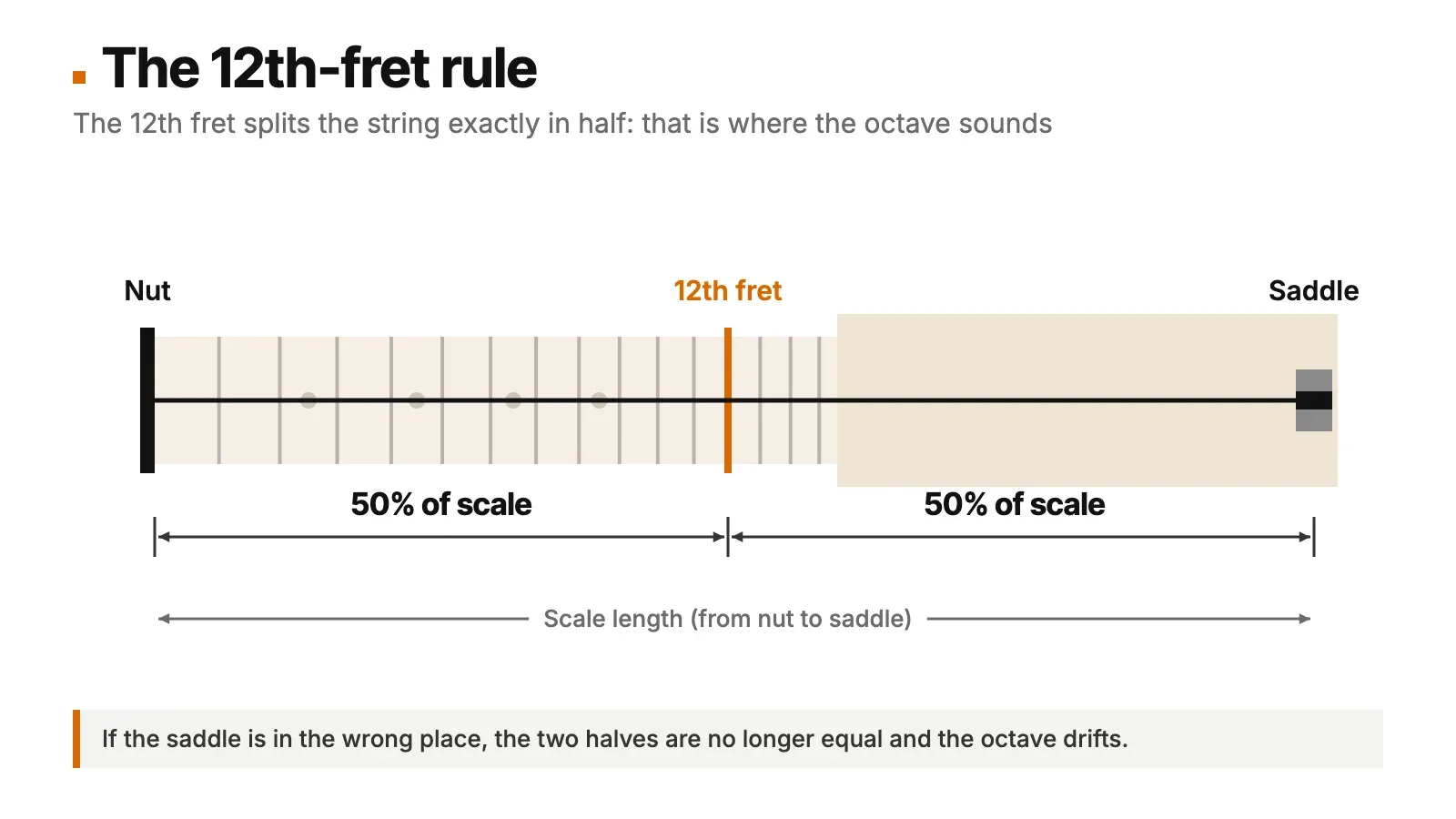
A string vibrates between two contact points: the nut, next to the headstock, and the saddle, on the bridge. The distance between them is the scale length. Frets are positioned so that each one raises the pitch by exactly a semitone, and the 12th fret sits right at the halfway point of the string: that is why it produces the octave of the open string.
The theory is exact, but a real guitar is not. Fretting a string stretches it slightly towards the fingerboard, which nudges the pitch up; on top of that, each string has a different gauge and stiffness. To compensate, the saddles can be moved forwards or backwards. Setting intonation means placing each saddle at the exact point where the note fretted at the 12th fret is precisely one octave above the open string.
How to tell if your intonation is off
Some symptoms can be heard before you measure anything:
- Open chords sound fine, but barre chords from the fifth fret upwards sound out of tune, even straight after tuning.
- The same chord played in two positions on the neck sounds in tune in one and off in the other.
- Solos and bends high up the neck always drift the same way.
- You have changed string gauge or tuning (half a step down, for example), or adjusted the action or the truss rod.
- The season has changed: humidity and temperature move the wood, and the setup with it.
The definitive test, though, is done with a tuner, and it takes less than a minute per string.
The test: 12th-fret harmonic versus fretted note
Tune the string with your tuner. Play the 12th-fret harmonic (rest your finger over the fret wire without pressing down and lift it just after picking): it should show the same note, perfectly in tune. Now fret the string at the 12th fret, with your normal playing pressure, and look at the tuner:
- It reads the same: that string is correctly intonated.
- It reads sharp: the string is too short. You need to lengthen it by moving the saddle back, away from the neck.
- It reads flat: the string is too long. You need to shorten it by moving the saddle forward, towards the neck.
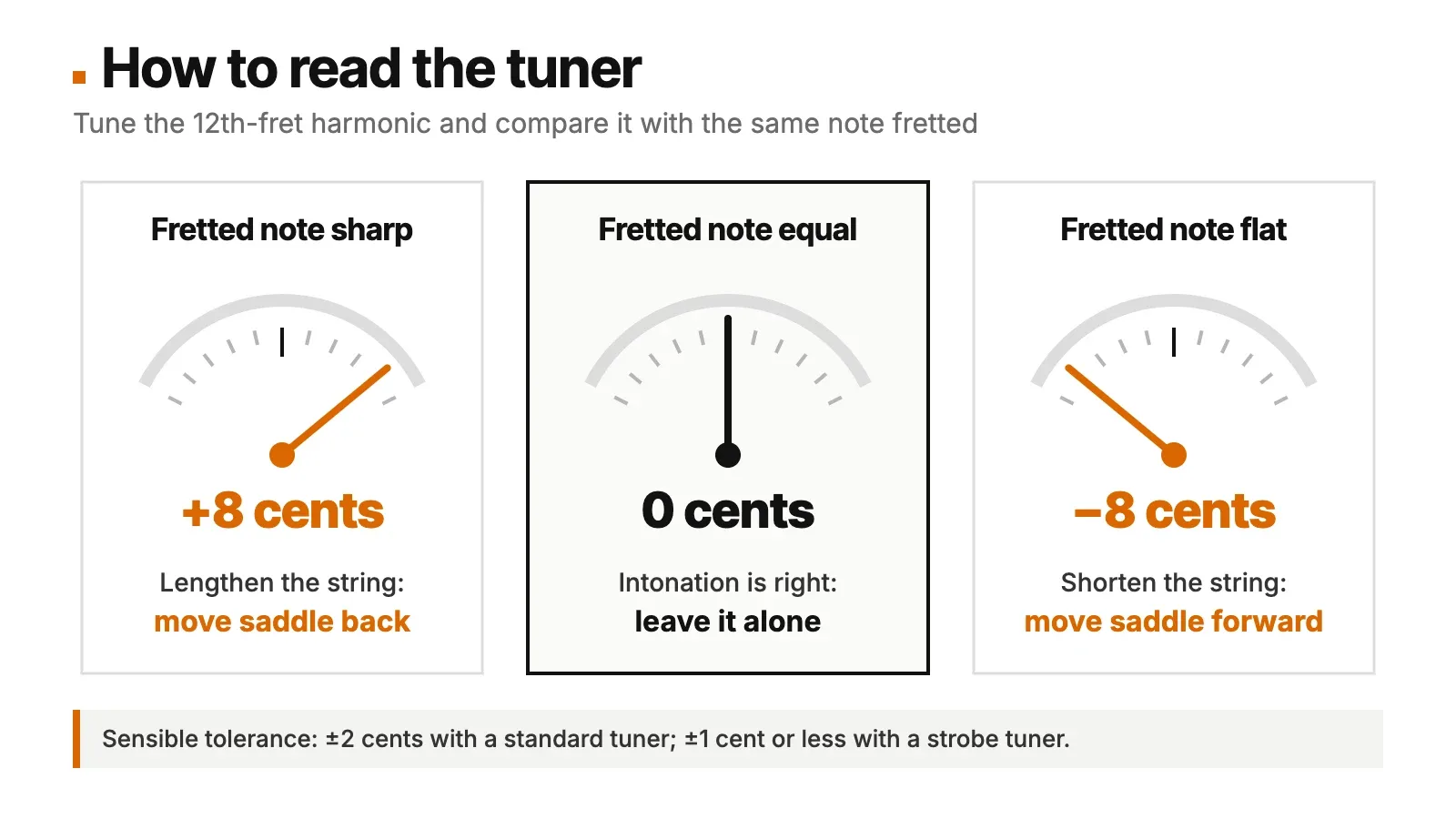
An easy way to remember it: "sharp, back; flat, forward". If the fretted note is high, the string needs more length; if it is low, it needs less.
Before you start: what needs to be right
Intonation is the last step of a setup, not the first. Do it too early and you will have to do it again. Check these first:
- New or nearly new strings. An old, corroded string or one with worn windings does not vibrate evenly and will never intonate properly. Fit the gauge you actually play.
- Truss rod and action already set. Changing neck relief or string height after intonating will throw the intonation out.
- The tuning you actually use. If you play half a step down, intonate half a step down.
- The guitar in playing position. Seated or on a strap, as you normally play, is better than lying flat on a table.
- A good tuner. A chromatic clip-on will do; a strobe tuner (pedal, clip-on or app) is far more precise and makes this job easier.
Step by step: setting intonation on an electric guitar
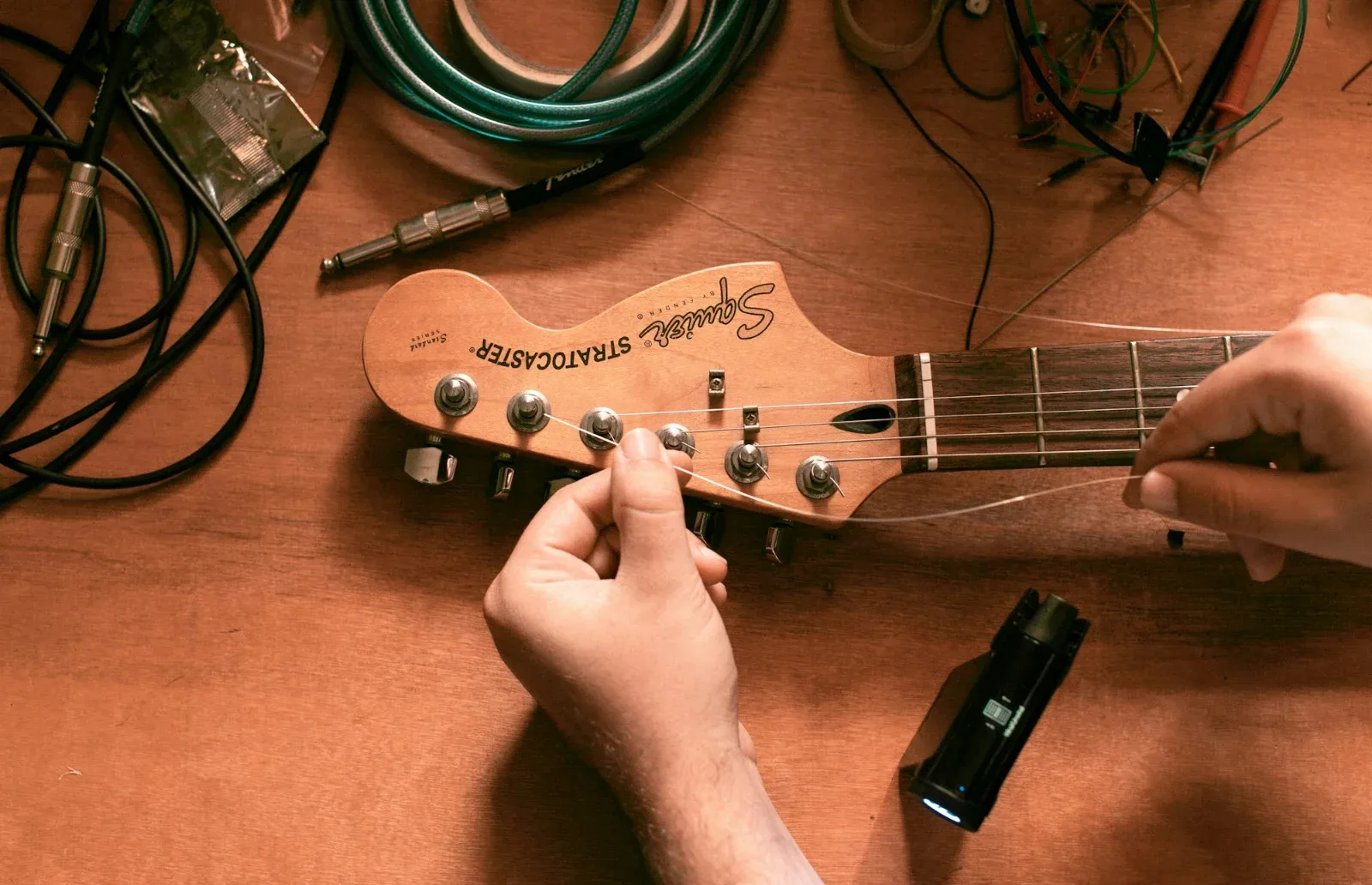
- Tune the open string accurately.
- Compare the harmonic (or the open string) with the note fretted at the 12th fret.
- If there is a difference, slacken the string slightly before moving the saddle: it avoids scratching the bridge and the screw turns without strain.
- Turn the saddle screw gradually, a quarter to half a turn at a time, in the right direction.
- Retune the open string. This step is essential: moving the saddle changes the length and therefore the pitch.
- Compare again. Keep going until the harmonic and the fretted note match.
- Move on to the next string and, once all six are done, check them all again: retuning some can shift the others slightly.
Fret the string with the same pressure you play with, no more and no less. Pressing too hard pushes the note sharp and fools the reading; it is one of the most common mistakes when setting intonation.
Which way each saddle moves
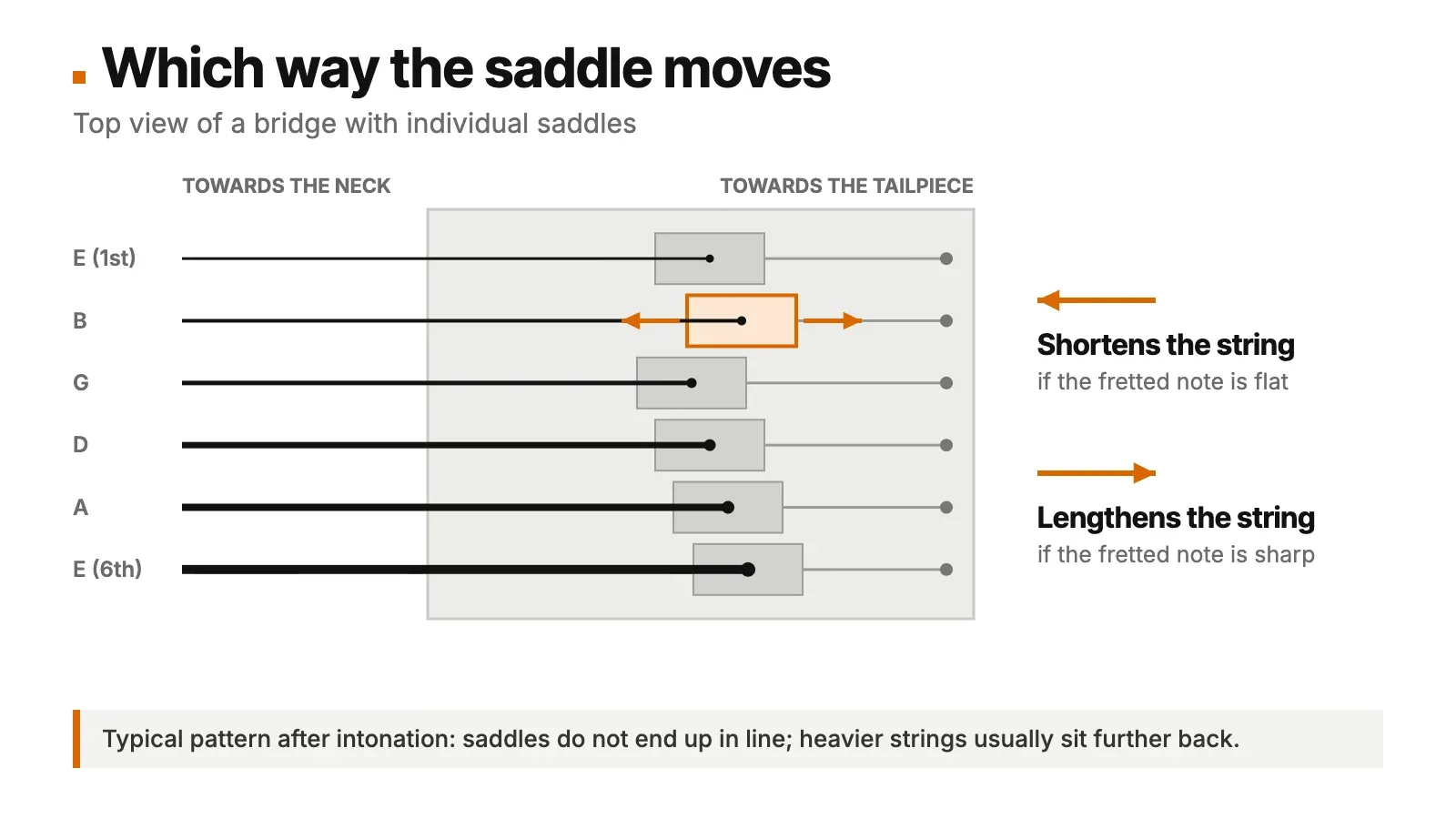
Once a guitar is properly intonated, the saddles do not end up in a straight line. The usual result is a sawtooth pattern: heavier strings tend to sit further back, and the B string usually sits further back than the high E and a plain G. Treat it as a guide: every guitar, gauge and action produces a slightly different pattern, and the tuner has the final word.
Every bridge has its tool
- Stratocaster-style tremolo bridges: each saddle screw is adjusted from the back of the bridge, usually with a Phillips screwdriver. If the bridge is floating, remember that slackening one string slightly detunes the others: retune them all before comparing.
- Tune-o-matic (Les Paul, SG and similar): the screw usually sits on the front or back face of the bridge and is turned with a flat-head screwdriver. On some models the bridge has to be turned round to reach every screw.
- Three-saddle Telecaster bridges: each saddle carries two strings, so intonation is a compromise. Compensated saddles, with an angled contact point, improve the result considerably.
- Floyd Rose and other double-locking tremolos: the saddle is locked with an Allen key and moved by hand. Slacken the string, move the saddle, tighten it and retune; with the locking nut open the job is much easier.
- Acoustic and classical guitars: the bridge saddle is not moved with a screw. If the intonation is clearly off, it is a job for a luthier.
What precision is realistic
With a standard chromatic tuner, if the harmonic and the fretted note are within ±2 cents, the result is good. With a strobe tuner you can get to 1 cent or less. Beyond that, your fretting technique makes more difference than the adjustment.
If a saddle reaches the end of its travel and the string still does not intonate, or every string is far out at once, it is worth checking the neck, the nut or the action, and if in doubt, seeing a luthier.
When to check intonation again
Repeat the test whenever you change string gauge or brand, tuning or action, after adjusting the truss rod, and as a routine check twice a year when the seasons change. It takes a few minutes and the guitar will thank you in every chord.
Photos: © Ken Barton and Alexis Baydoun (Unsplash). Graphics: ISP Music.
Manufacturers' websites
Leer en español: Guitarra desoctavada: cómo detectarla y octavarla en casa paso a paso