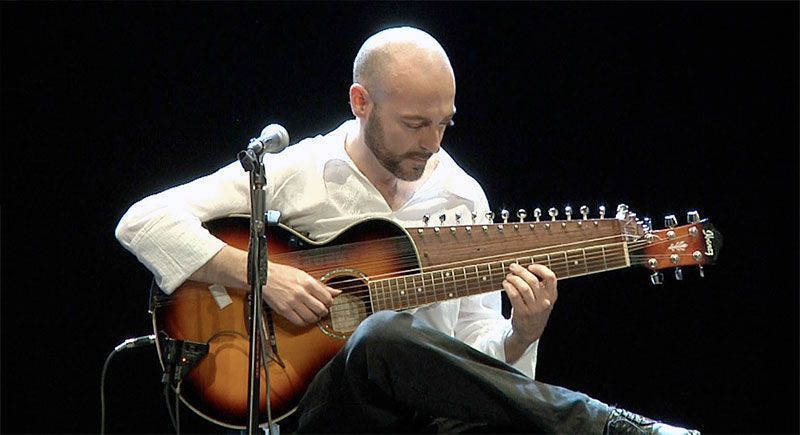
After a long and tortuous wait for the information that the press department of the artist’s label promised to provide us, and which kept being delayed day after day, we can finally bring you our interview with Raimundo Amador.
We are very proud to feature one of the most soulful guitarists in our country. My opinion joins that of dozens of guitarists who consider Raimundo one of the most outstanding figures on the guitar-centered music scene.
Ever since he played on the streets for a few pesetas at age 13 under the nickname Sargento Platillo, Raimundo has lived and played it all. From Camarón to B. B. King. From Björk to Ketama. And Veneno, and Pata Negra, and... His record of albums and collaborations is unmatched in Spain for the quality, charisma and purity of his contributions.
On his latest album, we find the flamenco vein, the Pata Negra roots and the light of Seville. But there are also Cuban influences from his work with members of Habana Abierta, rap with a collaboration from Mala Rodríguez, nods to Brazil through flirtations with bossa nova, bulerías with Tomatito, exceptional and unexpected ballads about “squatting” in hearts, hard rock, tributes to Camarón, instrumental tracks... And all of it with the color of Raimundo’s thousand guitars.
The more our knowledge grows, the more evident it becomes that technique on its own falls short. What’s necessary and magical is the “duende”; three notes from the soul say more than seven rational ones, as the saying goes. Raimundo Amador, know-how and passion: thank you for giving us your time.
Dear Raimundo, when did you start playing, and when did you decide to bring your guitar magic to the professional world?
I started when I was little, 4 or 5 years old. Professionally, I started with the Montoya family at 16.
What advice would you give young guitarists who feel a bit lost when it comes to starting a professional career?
Stop for a bit and look at things calmly.
What part of you is reflected in your albums?
Everything.
What do you look for in a guitar, and which guitars are you working with at the moment?
It depends on the guitar and the music I’m going to play.
But in the studio I usually use Gerundina, a Fender Telecaster, a Stratocaster.
I use the same guitars I always have.
What does an amplifier need to give you to serve you well? What’s your current amp setup?
It always has to be a tube amp, because the sound is warmer. I usually use a Fender Prosonic with a 100 W Selection head. I have another small 15-watt Fender.
Do you think a sound of tube amplification, overdrive and reverb is enough to deliver everything a guitarist has, or is that only for the blues? What’s your opinion of multi-effects units and pedals?
In my case, I go straight into the amp.
What does a guitarist need to do to improve, learn and evolve?
Study and never stop playing.
Continuing with our interest in your projects, what is your latest album, how have you evolved on it, and what do you have planned for the near future?
My new album is called “Isla Menor.” The clearest evolution is that there is more and more consistency over the years. The most immediate thing is a new tour.
As for live shows, once the summer is over, when and where can we feel the power of your live performance?
The tour will be soon.
Finally, what personal message would you give the guitarists reading you right now in Instrumentos y Sonido Profesional?
Never get bored and never stop playing. Hang in there and learn to wait.
Once again, I would like to thank you personally, and on behalf of our whole team and our readers, for your kindness in taking part in our conversations among musicians. Many thanks to Raimundo Amador.