 First of all, as with all our guests, thank you for kindly taking part. We're pleased to introduce percussion through a fine professional who undoubtedly sparks our interest and that of our readers. Dear Moy, looking at the tools you usually use, what kind of instrument(s) do you play regularly and what would you highlight about them?
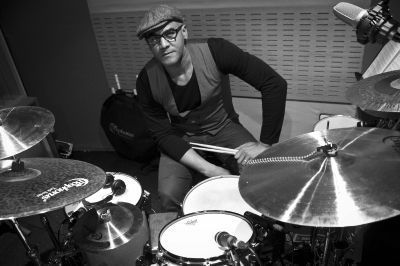
I usually use a 20" bass drum, a 10" tom and a 14" floor tom. A 14" or 13" snare. 13" hi-hats. A crash, a ride and that's it. That's how I feel most comfortable. I don't like playing with a lot of toms, and I don't like very big toms either.
At first glance it seems that guitar, piano or drums are the instruments beginners are most easily drawn to. What made you take the path toward drums and cajón?
As a kid I was very hyperactive. There was a psychologist who played drums, so she told my mother that playing would be good for me. And it was. I still remember the feeling. The immense joy I felt when I played. Soon after, I secretly decided that this would be my life.
Like two kids who become friends and swear loyalty to each other at recess, between math and biology class.
I know you've lived in different countries. Where did you study? What are your favorite styles?
Well, yes, I started studying in Mexico. I studied with lots of people; I went looking for teachers. I spent a few years studying that way. Then I went to New York, to a place called the Drummers Collective, which at the time was a school for drummers only, so we were all there in the same boat. I stayed six months and went back to Mexico. I spent some time working there and one fine day I went to study more formally at the Manhattan School of Music, also in New York. I spent five years there. That's how, between teachers and friends, you start doing your own little thing.
As for my favorite styles... That's a tough question. It's like favorite colors. It depends on the context. For example, I like the sky blue, even though blue isn't necessarily my favorite color. I like many styles. African music, Latin music. Jazz. I'm speaking in general. Each musical genre is very broad. For example, I say I like jazz, but actually I don't like all jazz; I like certain currents in jazz, certain styles within the styles.
In recent years I've gotten very into flamenco. Since Paris, where I also lived for a year, I've been totally hooked on flamenco. I'm truly passionate about this music. The rhythm, the singing, the lyrics, the dance. I love all of it. The guitar, the palmas (handclaps)... Getting to know it has enormously expanded my musical awareness.
What advice would you give musicians who have decided to set out on this professional path, and how does one become a good instrumentalist?
Every person is a world unto themselves. Every step we take is a world, a world of our own, unique and immense. That's why it's hard to give advice. I once advised a cousin of mine to cook his eggs well done because they tasted better that way... after a while, I no longer like my eggs well done. What bad advice I gave my cousin! The truth is you have to be serious on the path of music. Shutting yourself away is essential. Shutting yourself away shouldn't seem like something harsh. It's really being shut away in the cell of freedom. You have to look for freedom in that seclusion. Discipline is essential. A smart daily routine. It's little by little. Like a road where you never see the end. I think studying with the right person is also fundamental. Listening to the right music, studying it and getting inside it.
You have to do everything conscientiously.
Are drummers born or made?
We're all made. Life shapes us. It depends on what you live through. On whether you're lucky enough that someone, at some point, shows you some drums. On whether your parents let you make noise at home.
Now, there are people with a special talent. It's hard to understand how, for example, someone can play piano perfectly, and drums perfectly, and bass perfectly, and on top of that compose brilliantly. Let's say they're born with something. They're born and they're also made, because nobody gets out of the woodshedding. I think everyone who plays well has studied a lot.
Ultimately, if I had to choose between "born" and "made," I'd say without a doubt "made."
Do you think a drummer who has mastered one instrument can easily move on to another type of instrument, such as the cajón, or, on the contrary, does each instrument have such a different technique that it isn't so easy?
Certainly, if you play drums it's easier to move to the cajón than if you don't play anything and suddenly pick up a cajón. You already understand the concepts of rhythm and you've already worked on independence, and that makes things easier. You're also already used to discipline.
The cajón is, however, completely different and you have to study it a lot. Leaving aside cajón technique for a moment, there's another difficulty: flamenco has an immense language. There are many different palos (styles) that you have to know, and not only know, but study in depth to really understand.
The cajón is a very complete instrument with unlimited possibilities, like any other instrument that, at first glance, might seem more complicated to us.
We found the way you hold the sticks especially curious, as well as the setup and sound of your kit. Could you tell us what you look for in the sound of your kit?
Yes, you were asking how I hold the sticks... well, at first you spend a lot of time on technique, and in my opinion that's essential, because everything has an order and you have to go through it. Afterward you develop your own technique and hold the sticks however suits you best.
The way, say, Colaiuta holds the sticks is totally different from the way DeJohnette holds them. They also play totally differently. There's no single way in music.
If someone said Thelonious Monk didn't have good technique, they'd be mistaken, because nobody can play like him or compose the way he does. It's his own technique, and if he had a different technique, he wouldn't exist.
As for the sound, I like to create an atmosphere that's more percussive than drum-kit-like, so to speak. A succession of short and sometimes dirty sounds, or not so clean. Sometimes, as you've seen, I put a blanket over the drums and cymbals so everything sounds muffled and a bit ugly. Not everything has to be pretty either, right?
The sound of the snare, "hit" by you, was also especially pleasing to us, as were the rim and stick plays on the floor drum. What do you look for in a snare? What's special about your floor tom?
The floor tom you're referring to is actually a bombo legüero. It's an Argentine drum with a cowhide head. I don't always use it. It's because of what I was telling you about the percussive or ethnic sound I like. I like the wood, the rims. Of course, there's music that doesn't call for this, and then the bombo stays at home.
Which artist would you recommend?
Estrella Morente.
As for your latest and most recent projects, where and with whom are you working at the moment?
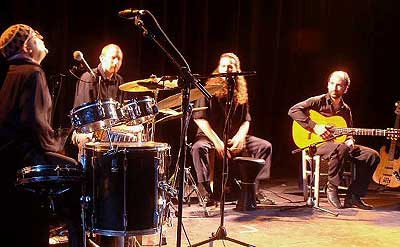
I have several projects I like. We're recording some interesting things with Jaco Abel (guitar), Pablo Martín (bass) and Jorge Pardo (flute); it'll come out sometime... Also with a singer-percussionist called Flavia, who's about to release her album too, which was a lot of fun to be part of. Also with Antonio Reyes, who is a flamenco dancer with tremendous power. With La Tati (flamenco). With Leo Minax, a composer and guitarist from Brazil whom it's always a pleasure to play with. With Pablo Maldonado. With José Antonio Galicia (who's a good friend). Also with the maestro Tomatito...
Like that, with different friends, playing, which is what we all like doing most.
Where can we see you live and with which artists?
Now, in October, Jaco, Pablo and I are going to give a course at the university. And also in Barcelona with the same trio, plus Jorge Pardo as guest.
There are also things coming up with Flavia and, well, with the people I mentioned we'll be out there playing. Hope to see you around.
Once again, thank you for sharing your time and experiences in our conversations among musicians, which undoubtedly encourage those who need role models given how hard and difficult it is to break into the world of music.
Thank you, Moy Natenzon.