 Rhythm born from within, combined with magic and the most exquisite technique
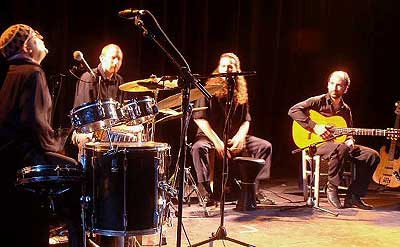
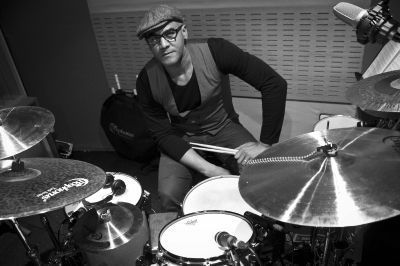
Just a few weeks ago, we had the opportunity to hear Fernando Favier live, and already at the soundcheck we were all truly grateful for the magic and power of this excellent drummer. Watching him play, the instrument seems to be an extension of his body, and the ease with which he performs, together with his warm rhythms and feel, leaves any amateur or professional musician open-mouthed.
Dear Fernando, first of all, thank you for joining our "conversations between musicians," which we have been running at ISP Música for some time now.
Are drummers born or made?
I think it's a bit of both. You have to know how to bring out talent and develop it; some of us start for fun, others because we're drawn to the drummers in bands or concerts we see that leave a mark on us. You start out very curious and very naively thinking that a drummer only needs a pair of sticks and some drums; then those of us who, through talent or sheer persistence, get a little further find that it takes many hours of study, a lot of patience and a good teacher.
What recommendations would you give to players who want to learn as much as possible, and what advice could you offer them as they fight to make their way in the professional world?
Lots of patience, study and paying close attention to the advice the more experienced can give them.
To make your way in the professional world, the key thing is to break down the communication barrier, to know how to share both as a musician and as a person, to make yourselves seen and heard, and to always be ready for when the opportunity comes along.
Speaking of drummers, which players do you think have influenced you or inspired you in your development?
The list could be endless, but I'll sum it up for you.
Elvin Jones, Buddy Rich, Jack DeJohnette, Peter Erskine, Omar Hakim, Stewart Copeland, Dennis Chambers, Ignacio Berroa, Enrique Pla, Changuito, Horacio "El Negro" Hernández, etc.
Is it healthy to cover every style or, on the contrary, do you think it's better to stick to one particular field?
"Cover" wouldn't be the right word for me; rather, it's about knowing all the styles in order to enrich our musical language. Also, something very important is our role within a band as a foundational instrument, which is very decisive in defining a musical style or direction.
What do you think is the hardest thing about this instrument?
Being aware of what you're playing.
Personally, I've noticed that drummers with simpler setups are often especially experienced. As for your setup, what is the most comfortable drum kit for you? And cymbals?
Before answering the question, I'll tell you something, and I'm sure you've seen it for yourself: the drum kit is a very complete, very versatile, very rich instrument. An instrument that invites you to play with its elements and timbres, and lets you express yourself with a very broad language depending on the setup you use in a given format or musical style.
In my case, and starting from the premise that you need to be comfortable to play, I identify very much with the jazz format, although it's not the only one I use. As you could see at the soundcheck, I use a somewhat classic format, but at the same time a different one in terms of sizes, for example:
- Drum kit
16" bass drum
14" and 13" snares
10" and 14" toms
I often combine elements such as cowbells, jam blocks, congas, frame drums, the flamenco cajón, etc. - Cymbal setup
20" ride
18", 17", 15" crashes
14" hi-hat
10", 6" splashes
18" ChinaWhich brands are you working with for hardware, cymbals and the complete kit, and why?
In search of what for me is the perfect combination, I use Mapex Orion drums, DW and Gibraltar hardware, and Zildjian K Custom, Avedis and Oriental series cymbals.
Mapex is a young brand with a team that has managed to find its place among so many well-known brands simply by listening to the demands and fresh ideas of many drummers. I particularly like their sound, their presentation and the variety of configurations they put right at your fingertips.
DW and Gibraltar are a great convenience and a guarantee for me, because they make playing easy and let me be creative when setting up or combining the kit with percussion elements.
With Zildjian, I really savor their overtones and their wide range of sounds, and for me they really are "the cymbals for a drummer."Since our special issue is about toms and bass drums, what do you look for in a bass drum, and what do you need from your toms (rack and floor)?
-
I think all drummers are looking for a pleasant, precise sound, sometimes dry, other times with all its overtones, etc. For me the bass drum is the center of the kit, and that's why I give it all the importance it deserves; I look for a very defined, round sound.
Among the toms I need to hear intervals that let me create both fills and rhythmic patterns. While recognizing that the drum kit will never be like a piano, I do see the need for us drummers to strive for impeccable tuning.
What do you think of MIDI drums and the digital field?
My greatest admiration and respect, above all for the infinite possibilities this field offers in teaching, performance and other areas. It gives us room to keep perfecting the instrument and our musical language.
As for your projects, what are you currently working on, and in which lineups can we find you?
I'm working on a project for an album for percussion only, and composing pieces for different percussion formats for educational work.
You can find me playing with, for example:
Joaquín Cortés (Flamenco Fusion)
Pavel y Gema (Fusion)
Grupo Echegaray (Flamenco Fusion)
Pedro Ojesto Trio (Jazz)
Rafa Santos's band (Fusion)
Grupo Oripandó (Latin Jazz)
Finally, as an excellent drummer, what would you add for our readers?
Just to wish them lots of luck and tell them that whatever we become depends to a large extent on our dedication and effort.
Once again, thank you for sharing your experience with us. Thanks to Fernando Favier.
Thank you very much to you and the magazine's team; and my respect to the readers.