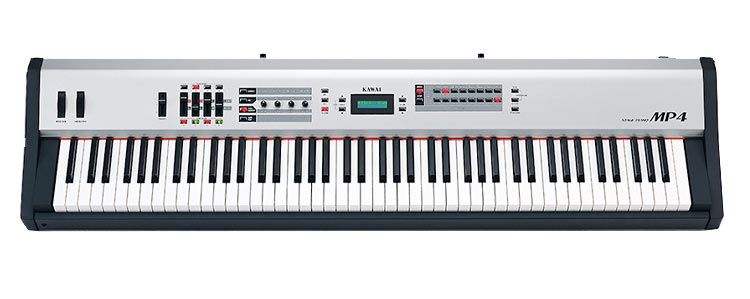
 Its 88-key keyboard has internal hammers of advanced design. The feeling of force, pressure and key size under our fingers as we press each key is quite similar to what we would find on a more conventional piano and not on an electronic one like this. I would say it is a piano keyboard that is not excessively “hard” but not as “soft” as that of many synthesizers either. In short, it is comfortable enough to help us with musical study as well as to deliver a lucid, virtuosic performance on it.
History
In 1890 the Japanese company Yamaha hired Koichi Kawai to build pianos. Kawai stayed at Yamaha until 1927, when he was able to create his own company, which has been called by his surname ever since: Kawai. In the following years he sustained it with his own research and development, improving his earlier creations. The reed organs of 1930 are an example.
Koichi Kawai died in 1955 at the age of 70. The new president, Shigeru, notably restructured the company, improving, among other things, the quality of the wood used to build its pianos and developing electronic organs, which in 1960 would become a major reference in the world industry. In 1963 they expanded the company to the United States with Kawai America, and created a university for music education with their own teaching methods.
In 1971, Kawai built a striking, spectacular transparent piano. In 1974 it established itself in Europe (in Dusseldorf, Germany) and in 1975 in Canada, reaching in 1978 the record figure of one million pianos built.
In 1985 Kawai began presenting its new digital piano models, and in 1989 Hirotaka Kawai, grandson of Koichi Kawai, was named the company's new president, marking a major renewal and business push. As a result, in 1998 Kawai produced its celebrated CA-750 digital piano, which many consider to rank at the very top worldwide.
Their Digital Piano Lineup Grew
After the success of their CA series, which was expanded and is still in production, they built the so-called CN, ES, HA, CL, PN and CP series with some very interesting variants, until the arrival of the MP series we present here. Two models stand out in it: the MP-9500 and the MP-4, which we will now analyze in greater depth.
Quality of the MP-4
Its 88-key keyboard has internal hammers of advanced design. The feeling of force, pressure and key size under our fingers as we press each key is quite similar to what we would find on a more conventional piano and not on an electronic one like this. I would say it is a piano keyboard that is not excessively “hard” but not as “soft” as that of many synthesizers either. In short, it is comfortable enough to help us with musical study as well as to deliver a lucid, virtuosic performance on it.
It essentially contains 64 typical General MIDI sounds, but I would say refined within the samples KAWAI created for this model, of excellent quality. As is often the case, the sounds begin with the classic pianos, the first of which, properly amplified, sounds as if we were playing a conventional grand piano. But we can still shade the sound of this or other pianos as if they were different real-world styles. Alongside these classic pianos there are other types, for example electric pianos, harpsichords, organs, orchestral sounds (strings and brass), choirs, and so on.
On the right, above the keyboard, there are two parallel rows of eight buttons each. In the top row we can set the type of “instrument” (piano, organ, strings, etc.) we want, and with the eight buttons in the bottom row we refine which style of “instrument” we want to sculpt, thus finding 64 (8x8) internal sounds of excellent quality. We can also conveniently access each of these sounds using other controls on the instrument's casing, as suits us. We can fine-tune these samples by equalizing them to our liking.
Polyphony and Effects
The maximum polyphony with which we can hear the MP4 simultaneously is 96 notes (much more than “average”), which is useful when recording several of its possible sounds. In real time, up to four notes can be layered, sounding together with each keystroke on the keyboard. However, some, such as strings, with a longer release time than the piano, can be used as its harmonic support.
It contains seven different types of reverb, as well as twenty other different effects, and a built-in four-band equalizer (bass, low-mid, high-mid and treble), which we can adjust at any moment and comfortably with individual knobs located on top next to the keyboard.
To find each effect, we press the button assigned to that purpose. After a few moments the different types of effects appear, which we can adjust at any time on the main sounds of the samples. These effects are of excellent quality and effectiveness on the final stereo signal. Notable ones include: flanger; chorus; four different types of delay; several tremolos; variations of phaser; rotary, effective on organ sounds, as if the speakers producing the sound were rotating on their axis; auto-wah, which produces a sweep on the attack of each note through automated filtering; a type of widened sound; and overdrive, which imitates the oversized sound produced in vacuum tubes. With all this, there is already plenty to work with comfortably and without the need to add other external gear, which we could nevertheless also incorporate. It is clear that the instrument was designed on the basis of the deep experience Kawai has gained.
Four-Zone Keyboard
Each zone can be set separately with the internal sounds described above or with external ones, for example via MIDI (for which it has connections on the back), or all of them simultaneously. In this way each zone can be programmed as “layers” with sound nuances, and even other settings such as “velocity” and the effects we choose can be varied in each zone, all of it also controllable separately or together when we press the keyboard's notes.
Easy Key Changes
I'm struck by how ingeniously easy they have made it on this instrument to change the keyboard's pitch practically instantly. We only need to press the Transpose button at the same time as any note on the keyboard. Automatically it will not only change the overall key but also the octave, returning to the original by pressing the corresponding “C” note. Something that seems so simple doesn't normally happen on other keyboards as easily as on this MP-4, and it is much appreciated.
Extras That Adapt to This Instrument
On the rear it has three of the typical DIN MIDI connections (IN, OUT and THRU), plus, separately, a USB port for linking and exchanging data between this machine and our personal computer. That way, if the MIDI cables are connected in addition to the USB, then when working with the computer the messages transferred via USB take priority, and these are recognized automatically on computers running Microsoft operating systems.
Also on the rear, there is the option of connecting three different types of pedals to make control changes with our feet without taking our fingers off the keyboard, so as to better express our artistic intent at every moment. One of the pedals that can be connected is an exclusive KAWAI design, called the F-1r, which is included with the unit. Other optional ones can also be connected, such as the F-2r, which is a dual pedal, as well as the F-1, which helps make instant changes to our settings.
The signal output from this instrument to an amplifier can be mono or stereo, with just one cable or with two separate ones from the connectors provided on the back. Also, on the front at the bottom left of the keyboard, it includes a special connection for listening on headphones and so working more comfortably. It also has a metronome for practicing at a steadier tempo.
In Short
The MP-4 is an instrument-machine conceived for serious work in our music studio, in a way similar to what we could achieve with a conventional piano, but with the advantage of taking up much less space (1356 x 340 x 172 mm) and weighing just 20.5 kg in total. We can store it upright in a closet and listen on headphones without bothering anyone around us.
In addition to superb “conventional piano” sounds, it has a total of 64 types of pleasant sounds, such as organs, various electric pianos, some very acceptable “strings” that can be combined as a “pad” with piano sounds or others, as well as “human voice” sounds that, adjusted with its equalizer and combined with one another, offer a lot.
It is a good machine that also serves as a “master keyboard,” that is, to control other machines via MIDI, able to sound at the same time as, or instead of, these good internal sounds. Of course it has the necessary controls for better handling of MIDI, such as the “Modulation” and “Pitch Bend” wheels, typical of the most prized master keyboards.
Its selling price, in my view, is really tempting for everything this MP-4 offers.
Although it has a metronome, it doesn't have silly percussion rhythms, which would turn it more into a toy. It doesn't even contain an internal multitrack recorder, although we can combine this unit with many others or with the external programs available for computers or other workstations that can record whatever we please, controlling them from the MP-4 through the connections provided here, via MIDI or USB.