 The Athens-based company takes analog simplicity to new heights with this 4-voice analog synthesizer. We're living in a time when the instrument market shows a clear passion for '70s and '80s vintage. Not just in keyboards, synths, etc., but also in amps, effects, pedals and many other instruments. Builds characterized by sturdiness, generally metal enclosures and a retro look in their buttons and knobs. Dreadbox doesn't stop at appearance, which, by the way, passes with flying colors. It oozes this retro analog philosophy from the depths of its electronic soul.
Unboxing
The good old-fashioned way. We have the product in our hands, which is the best way to understand the manufacturer's goals and become aware of what the product offers, its strengths and weaknesses. This is a cutting-edge four-voice analog synthesizer. A handmade desktop synth built in a metal enclosure.
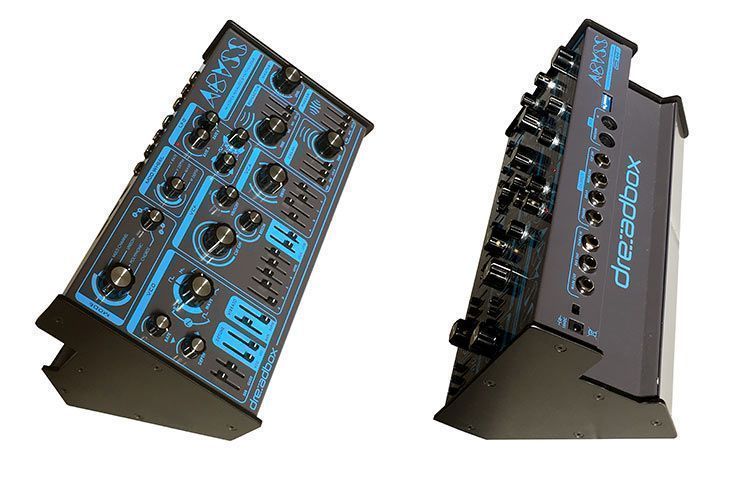
One of the most attractive things about the Abyss control panel is its simplicity. There are no multi-function buttons hiding long labyrinths of operation. What you see is what you get, and it's all clearly within reach.
At a glance
Mode panel
Mod Wheel
LFO
VCO, Detune vibrato
VCF
Drive, saturation
Delay
Reflector
Master
Phaser
It seems it was in March 2016 that the company decided to create the Abyss. Its goal was clear: to build a polyphonic synthesizer with very warm sounds and a retro vibe illuminated by minimalism. Its greatest efforts focused on finding the right approach to keeping the 4 voices harmonized as they add up and intermingle to give the synth its power.
The Abyss can work in four different modes. Running through them quickly, we have Multichannel mode, in which the four voices are controlled via separate MIDI channels; Unison mode, which creates a thick, detuned stack; Polyphonic mode, for standard four-voice polyphony; and finally Chords mode, in which a single note triggers predefined four-note chords.
Add to this a small panel of switches on the back that lets you control MIDI channels and have the instrument work in multitimbral mode, while using the chord selector to select and edit aspects of each voice individually.
Sounds that prioritize warmth, personality and density of the sound source over the versatility and flexibility of other more "modern" synths
All of us who tried the synth agreed that its virtues center on the power of its effects. Quite deep and "wet". It generates sounds that prioritize warmth, personality and density of the sound source over the versatility and flexibility of other more "modern" synths on the market. Another advantage that may justify the price of the "device" is the ability to process audio through the external input, which will route signals through the Abyss's entire signal path.
Just as with the sound of a good guitar amp or a not-very-versatile but hard-hitting overdrive pedal, I'd sum up this minimalist retro philosophy as "better a little of something good + the artist's creativity than a thousand empty sounds with little sonic substance"
Modes
Multichannel mode
Each of the four voices is controlled via a consecutive MIDI channel. This way you can play four different melodies independently or use each Abyss voice as a monophonic instrument. It's also useful for creating complex melodic lines using four monophonic sequencer channels.
Unison mode
The synth brings all the voices into play to create an especially thick, warm monophonic sound. We work on them with the detune parameter to detune and shape a unique sound.
Polyphonic mode
Lets you play polyphonic chords or melodies, distributing the different notes to different voices. Each Abyss voice is individual
Chords mode
Here we play one note and the Abyss responds by playing a four-voice chord. We can select any of the 6 preset chords or edit our own custom chord using the chord rotary switch.
Next to the MODE knob there's a smaller one that runs through positions A to G. The first six correspond to preset chords, while the last one (G) recalls our own chord.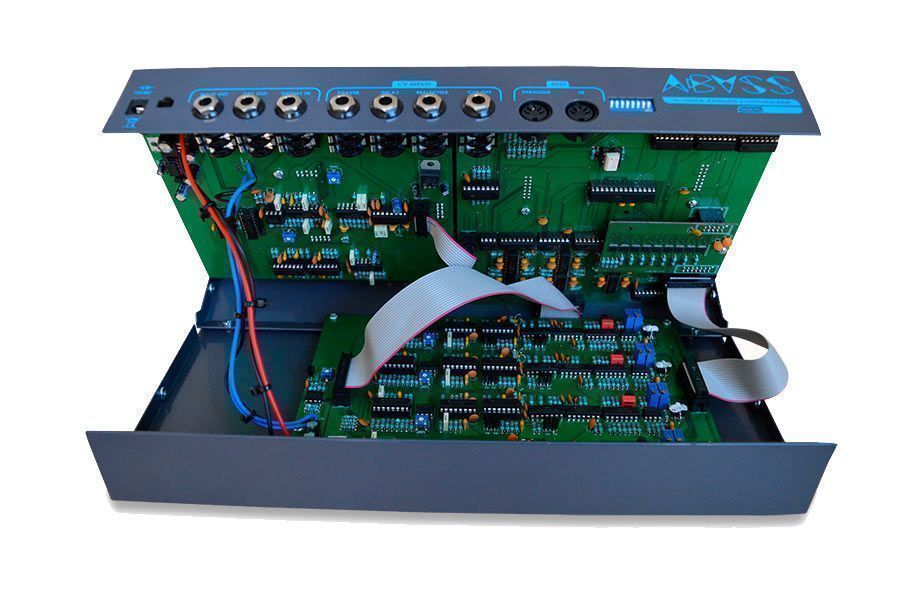
Sound processing
One of the virtues of this type of synthesis is being able to process our sounds with effects (phaser, delay, gain, detuning), filters, coloration, depth, etc. This is where this Greek synth puts a good arsenal at your disposal which, as I said at the start, is easy to use and to find "at first glance".
The Abyss's oscillator sections feature per-voice glide and vibrato controls, plus a detune control to offset the four voices.
Oscillator (VCO)
Sawtooth-core VCO design. These oscillators tend to be unstable: they rise to the sweet spot. A "liquid" section.
Each VCO is equipped with:
1 oscillator
1 sub octave
1 dedicated vibrato
1 Glide control
Filter (VCF)
Each of the Abyss's 4 voices has a 24dB/octave (4-pole) filter with an envelope generator
As with the VCO, looking at the panel once again, you can see that the Abyss's filter section is made up of 4 areas:
The actual filter controls: cutoff and feedback (resonance)
ADSR envelope generator. ATTACK: rise time; DECAY: fall time until the sustain level is reached; SUSTAIN, RELEASE and DEPTH.
LFO controls. Modulation from the 2 analog LFOs to the filter.
Velocity. Changes the behavior of the filter envelope
Amplifier (VCA)
It can be driven almost to the point of distortion. ATTACK, DECAY, SUSTAIN, RELEASE
Reflector
A 1054 BBD delay (50 ms maximum delay time) which, combined with an LFO, can produce chorus, flangers, static flangers, tape effects and vibratos.
Delay
Which in turn has the FEED, MIX, LFO B and TIME controls
Phaser
Here we control RES, BIAS and LFO B.
Dual Analog LFO
We could say it sits between the filter, reflector, delay and phaser. We control LFO A speed, LFO B speed and the waveform selector.
Mod Wheel
V RATE (vibrato rate), V DEPTH (depth), WAVE (Wave Shape) and W DEPTH (Wave Shaper LFO)
 Specifications
- All discrete analog components
- 4 play modes: unison, polyphonic, chords (+ user chords) and multichannel (multitimbral over selected controls)
- 1 VCO + 1 sub-oscillator per voice
- White noise generator
- Independent wave shaping modulator
- Polyphonic 'glide' function
- 4 independent LFOs (1 for each voice) for controlling vibrato
- Variable rate and delay depth
- Vibratos and 'glide' can be offset using the detune (vibrato) control
- VCO auto-tune function
- 4-pole, 24 dB/Oct resonant low-pass filter (based on the Murmux series)
- Dedicated ADSR envelope generator for the filter
- Velocity sensitivity over EG attack rate or EG level
- Dedicated ADSR envelope generator for the VCA
- OTA 'drive' circuit
- Reflector: 1024 BBD delay for chorus/flanger or static flangers
- Hybrid delay circuit as found in the Erebus
- 4-stage analog phase shifter
- 2 analog LFOs with 4 waveforms each for controlling the filter, reflector, delay and phaser
- 4 mod wheel options
- Fine pitch control
- CV control over the filter, phaser, delay and reflector
- Dry output (no effects)
- Signal input (at the effects stage)
- MIDI In / Through
- Metal enclosure
- Dimensions: 350 x 195 x 170mm
- Weight: 2.38kg
- Approximate price: €1,100
Format: Desktop
Polyphony: 4 voices
Sound engine: Analog
MIDI interface: 1x In, 1x Thru
Storage media: None
USB connection: No
Effects: Yes
Arpeggiator: No
Number of analog outputs: 2
Digital output: No
Display: No


