 Today nobody is unaware of the name of the great Japanese brand YAMAHA, which, after making such diverse revolutionary products prized on the world market for their excellent development and price (motors and industrial applications for home and leisure), decided in the 1960s not only to produce professional musical instruments but also, from 1966, to create its own music schools and learning methods, which it then spread with great success around the planet.
And it is especially since the 1980s that YAMAHA has launched impressive amplifiers for guitars and electric basses, also designed in-house.
Why choose a combo?
Musicians’ demands eventually reach the designers, who, with new equipment, try to satisfy the demand of those who remain faithful and devoted to a brand like YAMAHA which, in addition to its extensive experience in making musical instruments, has ample information, thanks to its own schools, to manage and refine all the practical and useful aspects that professional musicians require at any given time. Thus, it seems to realize that we no longer tend to demand a large amplifier to hear the sound of our bass, not even for the stage, because besides the fact that its enormous size would make it hard to move from place to place, it might prove insufficient on its own to cover a large concert hall.
It is generally “easier to carry” and more efficient to concentrate the amplification in a combo. The engineers who handle the house sound (through other speaker systems) can easily pick up the sound coming from our combo, which will at the same time be our best monitor, since we can control it ourselves on stage and set the volume according to our needs without having to “beg” distant engineers to provide it through monitors that only they can control.
This type of combo is also very efficient off the stage, for example in a recording studio and even at our regular workplace, where we need reliable quality free of unwanted noise. YAMAHA’s effectiveness in this field is remarkable.
The BBT series of bass amplifiers
In its BBT 500 models, YAMAHA offers new solutions for the instrumental tools so many of us musicians require. They have developed the BBT 500H amp head, fully digital, which delivers those “tube” sounds that so thrilled musicians in the ’60s, but with up to 500 watts of power, a figure they couldn’t even have imagined back then (when The Beatles played Madrid’s Monumental bullring in 1965, they used the extraordinary VOX AC-100 amps, which had no less than 100 watts). However, we won’t talk only about power, because there are surely amps that beat this figure already. Perhaps more important is the great development of its DSP technology and the guarantee of the YAMAHA brand.
These amplifiers are specifically conceived for the bass player and so they focus on excelling especially in the frequencies most needed, around the 400 Hz band, achieving this with brilliance and at the same time with a solidity in the low end that can be felt satisfyingly in every note we play on our bass.
As for combos, YAMAHA offers two main models, the “110” and the “115,” whose biggest difference is the type of speakers: 10 inches in the first model, 15 inches in the second. Both also have a high-frequency speaker (tweeter), as well as a new digital technology called “groundbreaking” that seems very efficient. They include a five-band parametric equalizer. Programmable effects can be added, even via MIDI (the back has the corresponding MIDI in/out connections), which isn’t usually so common in this type of combo, and they also include ¼" jack inputs and outputs as well as balanced or unbalanced XLR connections, very useful especially when working in combination with the line signals that are ultimately controlled from the main mixing console in a concert hall. Of course, also thinking about the musician’s needs, it has a headphone output with its own dedicated volume knob, useful in a great many cases, even on stage (for example, to tune the bass).
In addition to this BBT series of amps, YAMAHA’s lineup includes the “F series,” whose current standout is the “F-20” model, also intended for bass but perhaps designed more for rehearsals and even recording, although without a doubt less attractive (though no less efficient) than the combo models mentioned above.
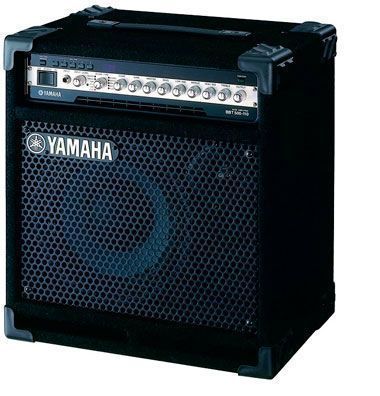
Features of the BBT 500-110
With a Class D amplifier and an output of up to 500 digital watts, it can process its signal with up to eleven different types of spectacular sonic results, letting us choose a bass sound for each occasion and circumstance in which we think we need one. If we use this amp with different types of bass guitars, we can process each of them with completely customized sonic results.
Its efficient five-band parametric equalizer lets us dial in exactly the type of sound that can satisfy us at any given moment. We can save these settings permanently or adjust them later, using its five memory slots, always available and easy to store individually.
It even adds a special compressor that gives the notes coming from our bass, connected to this combo, better roundness and attack, thus giving our musical performance a better lift.
On the back there is another output in case we want to add an external bass speaker as an extra to complement the two already built into this combo, to spread the sound better around the hall, or if in certain circumstances we thought that was necessary.
In addition to the compressor, it has an output limiter, a gate circuit, various filters and special sound simulators, a 48 kHz sampling rate, a crossover, inputs and outputs to add other external effects, a headphone connection, etc. For that reason, it strikes me as much more than complete and extraordinarily well equipped with very desirable features, which don’t usually appear on a great many other competing amps or combos. It operates at 230 volts, at 50 or 60 Hz (in Spain we only use 50 Hz) and draws only 130 watts of current.
My overall impression
Frankly, I was surprised by the sound capacity my bass achieves when connected to this combo, considering the overall size of the cabinet. Its range of “attack” and “depth” settings can be adjusted so variably that it is like having many very different combos in one piece. Likewise, thanks to the five easily accessible and storable presets, its versatility is very broad. With this combo we could even amplify any other type of electronic musical instrument satisfactorily.
It “holds” the low end quite a bit better than its size suggests (there is always a limit), surpassing a “supposed comparative average.” When using it with the bass close to and in front of its speakers, I can feel that even the air moved by the larger speaker’s cone “moves me,” but without distorting, even at a fairly considerable volume. It also doesn’t feed back unless we really want it to, in which case we can select the effect electronically and in an absolutely controlled way.
As for EQ, the range is impressive. With its highs “maxed out,” the background noise is more than tolerable. We also have many ways of shaping it, even with a knob on the back that controls the sound output through the small high-frequency speaker. Its five-band parametric equalizer is truly effective to an uncommon degree and has a very distinct separation of frequencies, even in its middle bands.
It is manageable both for its weight (5.2 kg) and for its size (460 mm wide, 340 mm deep and 555 mm high), both small in relation to the power with which it pushes our sound. The handle on its cabinet lets one person move it, although it should be transported in a cover or a wheeled case better suited to the purpose.
As a stage monitor it seems excellent and sufficient to me because it also has the outputs that may be needed to send the signal to a larger system. It has balanced and unbalanced connectors, so it won’t be necessary to amplify it with the typical mic in front of its speaker since, despite the mic’s directionality and high quality, it will always be affected by other undesirable signals, such as the “puff” sounds the speaker makes as it moves when hit with our bass signal. Since the signal comes straight out the back, it will easily reach the console and we can process it as we like from the combo, with the effects and type of tone that come from our instrument and the sound we really want heard throughout the hall.