A drum kit is perhaps one of the hardest instruments to record. It is a musical instrument made up of multiple elements, most of which have little to do with one another: snare, kick, toms, hi-hat, cymbals...
Each of these elements has very different characteristics, both in timbre and in dynamics, and yet they all form a coherent whole when played properly. So the job of a good engineer is to capture that sound, whether with a single microphone or with several: the ultimate goal is for the instrument to be properly represented. And while we're at it, if it's not too much to ask, the drums should sound with punch, depth, body, brightness, attack, size, power, dynamics...
Some experienced readers are probably thinking “well, it's not really that hard, you just have to choose the right mics and put them where they sound good, and then choose which preamps to run them through...”.
And they would be right, because ultimately the key lies in one word: experience. Once you have tried placing every kind of mic in front of every kind of drum kit (or instrument in general), and then run them through every preamp within reach, you end up discovering certain “tricks” that make the final result better. Now other readers will be thinking “it would be great if people with so much experience told us how they do things...”.
And that is precisely what Michel Martín is doing in his master classes. In fact, he goes a bit further, and not only reveals how he does things, but also demonstrates techniques from engineers of the caliber of Al Schmitt, Eddie Krammer, Bruce Swedien, Bob Clearmountain... We at ISP Música attended the master class Michel gave on acoustic drum recording techniques.

* Photo: Bruce Swedien
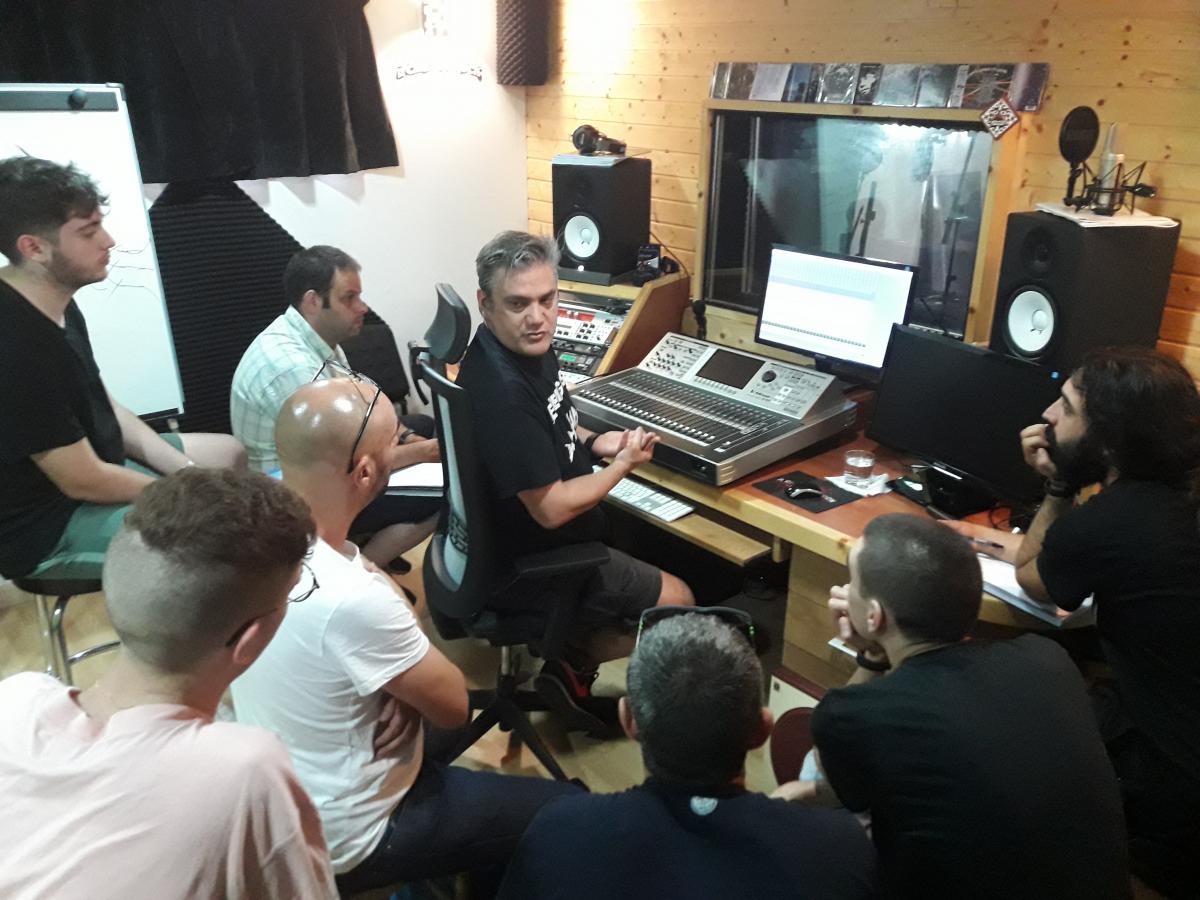
The master class was divided into a first, theoretical part on the evolution of microphone technique, and a second, practical part, in which we were able to use the magnificent facilities at CATA to mic up a drum kit using several different techniques.
A real treat of a master class, and it covered a lot of ground...
A little theory and history
The first part of the master class came with abundant documentation, which took us on a journey through the history of recording and revealed how microphone technique has evolved over the years: to know where you want to go, it is very useful to know where you come from.
The journey began in the 1930s, when a single mic was used for all the instruments, and continued into the 1940s and 1950s, when a mic dedicated exclusively to the drums started to be used. The images showed sessions by, for example, Elvis, and how the mic was placed above the drums (overhead) to capture the overall sound of the instrument.
Next came the 1960s, and names like The Beatles, the Beach Boys, Hendrix, Led Zeppelin, etc. came up to explain how their engineers (Geoff Emerick, Al Schmitt, Eddie Krammer...) were already starting to use a pair of mics on the drums: one as an OH and another on the kick. Coles 4038, AKG D20, D25 and C12, Neumann U47 and U67...

* Photo: Coles 4038, AKG-D25 - Neumann U-47
Once again, the images let us see historic recording sessions and how the drums of these now-legendary bands were captured.
Moving into more recent history, the artists mentioned were Michael Jackson, Brian Adams, Nirvana... and how engineers such as Bruce Swedien, Bob Clearmountain or Steve Albini were already using multiple microphones on the drums, laying the foundations of the sound we are used to today.

* Photo: Steve Albini
In this case, the images not only let us snoop on the mics and how they were arranged around the kit; they often also showed how all kinds of gadgets (baffles, gobos...) were used to achieve the sound these geniuses had in their heads. The documentation ended with a review of stereo miking techniques and a more than interesting list of the favorite mic set of each of the engineers who had been mentioned.
As if all this information were not enough, the talk was rounded out with all kinds of tricks, comments and advice that Michel offered depending on the topics covered and the questions the attendees asked.
I don't think I'm wrong in saying that everyone there finished the morning with plenty of “I've got to try this at my next session” moments.
Getting down to work
After a well-deserved lunch break, the master class continued, this time in CATA's Studio One. As Michel had pointed out during the morning, one of the fundamentals of getting a good drum sound is having a good drummer playing a good drum kit.

* Photo: Lauren Stradmann
On this occasion, we had the pleasure of having Lauren Stradmann, a well-known musician on the Spanish scene who will be backing Raphael on tour next season. While Lauren checked the setup of his kit, Michel explained the techniques that would be used to mic it.
To check the differences a dynamic and a condenser bring to the snare, both an SM57 (Shure) and a KM184 (Neumann) were placed on the top head (time-aligned), and an identical pair on the snare-side head. The goal was not to use all four mics at once, but to discern the nuances each type of mic brings, in order to decide in which situations one or the other (or a combination of them) may be more suitable.
In a similar spirit, three different mics were placed on the kick. The first was a Sennheiser 421 (M position) inside the shell, aimed at the beater. This mic was meant to be combined with a Neumann U87 placed some distance from the resonant head (outside), so that the former would capture the beater's attack and the latter the lowest frequencies of the kick.

* Photo: Sennheiser 421 and Shure SM57
Once in the control room, we saw how EQing these mics in different ways can produce a variety of kick sounds, depending on the needs of each situation. The third mic was an AKG D12, placed outside right against the resonant head, which was used to get a “vintage” sound from this drum.
As for the toms, Bob Clearmountain's technique was used, placing one mic on top and another underneath, so that the level ratio between the two mics lets you control the toms' sustain. On both the rack tom and the floor tom, a 421 captured the top and a 57 the bottom.

* Photo: Schoeps Mk2 and Neumann KM 184
The last element left to mic, the hi-hat, got a KM184 placed above it. Here too, Michel explained the different ways this mic can be positioned and the benefits each position brings.
For overheads, two stereo pairs and one mono mic were set up. The first was a spaced AB pair above the kit, made up of two KM184s. The second stereo pair consisted of two U87s in ORTF, placed behind the musician's head. The mono OH (a Coles 4040 ribbon) was also placed at the height of the drummer's head, but this time centered over the kit.
Finally, two more stereo pairs were set up to capture the room ambience. The first was a pair of Schoeps CMC 6-U in ORTF, placed in front of the kit roughly three meters away.

* Photo: Neumann U87
The second ambient pair consisted of two spaced U87s, about two and a half meters from the instrument, but in this case facing away from the kit, to avoid picking up direct sound and thus emphasize the sound of the room.
In the control room
To prevent coloration from the preamps and be able to hear faithfully what each mic was doing, they were all treated the same way, going straight from the Millenia HV-3DX preamps into Apogee AD-16X converters, and from there into Pro Tools HD.

* Photo: Apogee AD-16X converters
While Lauren showed infinite patience and kept a steady groove (breaking it with the occasional fill, as instructed), each of the mics was opened up and analyzed, both on its own and in combination with others. This let us hear the differences and advantages of each mic compared with the rest, and how each one stamped its own personality on the sound it captured.
The three OH options provided three different images of the kit, to which different mics were gradually added, ending up each time with a different overall sound.
 * Photo: Millenia HV-3DX preamps
It would be hard to list all the combinations that were tried, as there were many, but it is worth highlighting that all of them were very “usable,” and they illustrated the wide variety of creative options available when miking this instrument.
Although perhaps one of these combinations deserves a mention... The sound achieved with the Coles 4040 and the D12 was simply spectacular. In short, the second part of the master class was also packed with useful information, seasoned with plenty of tips and tricks from the master.
About Michel Martín A graduate in Audio and Sound Reinforcement Systems from the Polytechnic University of Valencia (who also studied Electronics, Electroacoustics and Psychoacoustics), Michel Martín has been in the music world for more than 25 years and has worked with artists of the caliber of B.B. King, Take That, Amaral, La Oreja de Van Gogh, Estopa, Alaska y Dinarama, Los Ronaldos, Los Bravos, Mecano, Marta Sánchez... to name just a few.
Fortunately, all this experience does not stay with him alone, and Michel has been teaching in Spain for many years, at several different schools. More than one ISP reader has probably had the chance to attend one of his classes.
Alongside his studio and live work, Michel is currently teaching a postgraduate program he designed himself at CICE. He also gives master classes on demand, like the one described in this article.
We would like to take this opportunity to thank him for his teaching work, and we ask and encourage him to keep it up.
Microphone set used
|
Snare Top Neumann KM184 |
Stereo Overhead B ORTF behind the drummer's head Neumann U87 |
||||
|
Kick Inside Sennheiser 421 |
Mono Overhead Above the drummer's head Coles 4040 |
||||
|
Hi-hat Top Neumann KM184 |
Stereo Room A ORTF in front of the kit at about 3m, at |
||||
|
Tom 1 Top Sennheiser 421 |
Stereo Room B Spaced pair, about 2.5m in front of the kit, at ear height, facing away from the kit Neumann U87 |
||||
| Floor Tom
Top Sennheiser 421 |
Stereo Overhead A
Spaced AB pair Neumann KM185 |