
This is the link in the audio chain we pay the least attention to, and yet it is still one of the most important. The power amplifier is what delivers the energy the loudspeakers need to produce audible sound. In the audio chain, it sits between the sources (mics), the preamps (mixing console) and the loudspeakers. The signal coming from the various audio sources is on the order of a few millivolts, and it passes through the different links until it reaches the tens of volts needed to move the loudspeaker diaphragms.
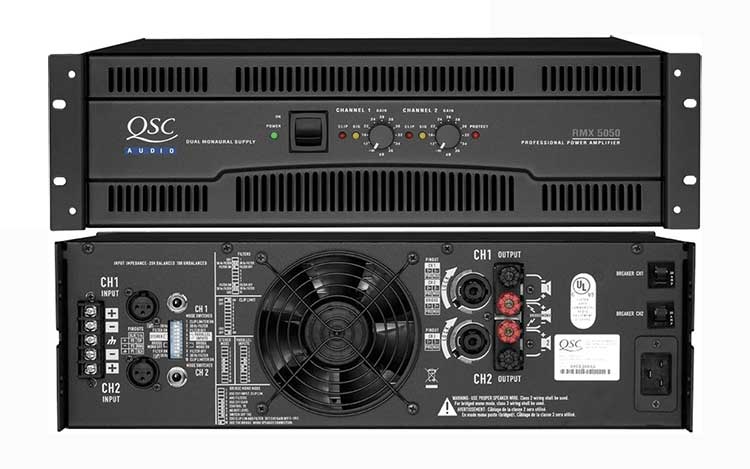
Until recently, power amplifiers were physically huge and heavy, with two inputs and two outputs. Today they have evolved a lot, integrating a multitude of options and connections into small, lightweight packages.
Decibel scales
Logarithmic relationships between units:
For intensity, the logarithm of the ratio between output and input intensity is multiplied by ten: I= 10log I/Io
The same applies to power: P= 10logP/Po
For sound pressure levels, it is multiplied by 20: SPL=20logD/Do
Reference values: ratio / decibels by unit
0 dBm = 0.001 watt (1 milliwatt)
dBm = 10 x log(power / 0.001)
0 dBW = 1 watt
dBW = 10 x log(power / 1)
0 dBu = 0.775 volts
dBu= 20 x log(voltage / 0.775)
0 dBv = 1 volt
dBv = 20 x log(voltage / 1)
0 dBSPL = 0.0002 dynes / cm2
dBSPL = 20 x log(Pressure / 0.0002)dBSPL

POWER AMPLIFIER SPECIFICATIONS
Input sensitivity
This is the input voltage needed for the amplifier to deliver its rated power. This sensitivity is generally between 3 and 6 dB, that is, between 1 and 1.5V, which corresponds to most professional mixing consoles, 0dB = 4dBu.
We need to pay close attention, since these values are sometimes given in dBV and sometimes in dBu. We already know from the tables above that 0dBu is 0.775V and 0dBV is 1V, so 3dBu=1.09V, while 3dBV is 1.41V.
Processed systems, that is, those that include a signal processing link (limiters, filters, EQ…), usually operate at a higher gain, around 3.5V, so the amplification gain is 26dB.
The power amplifiers in our home hi-fi systems usually have a sensitivity of -10dBu, that is, 0.25V, or of 0dBu, 0.775V. This means these amplifiers will reach their rated power much sooner, but also that they will clip much sooner (for example, when connected to a professional mixing console), so there is a good chance our loudspeakers won't withstand the resulting distortion for very long.
Professional amplifiers, such as those from the American brand CROWN, for example, usually offer all three options so the power amplifier can be matched to the system. Almost all amplifiers have a sensitivity of 4dBu.

Amplification gain
Another element not everyone understands the same way is the volume control, which also tends to have the most confusing markings; we have come across scales from 0 to 10, 0 to 100 or -60 to +4, and even +18 to 0! As usual, manufacturers can't agree on how to label the appropriate values on their equipment.
This potentiometer, which we may find on the front or back of a power amplifier, is not a simple volume control but an input gain control, so its proper position is all the way up.
Most amplifiers have an amplification gain of 32dB, which means that if we feed 4dBu into the input, we will get 36dBu at the output. In terms of voltage, feeding 1V into the input gives us 40V at the output; but be careful, this does not mean that if we feed in 21V, that is, 28dBu, we will get 60dBu; what we will get is the amplifier's protection circuits kicking in, or its destruction. Clearly the electronic components could not withstand working at these values. Therefore, any power amplifier is capable of delivering somewhat more than its rated power when the input voltage is increased.
So if the nominal output of our mixing console and the input of our power amplifier are equivalent, setting our master output to maximum will be fine, as long as the power of our amplifier matches the power our loudspeakers can handle and the level on the console is 0dB.

Impedance
Today's power amplifiers accept a nominal load of 4 ohms, although some brands can go down to 2 ohms, and even lower! That is, high voltage levels.
We must always respect these manufacturer specifications, because if we connect two 4-ohm loudspeakers in parallel, the power amplifier will see 2 ohms, straining to supply that large energy demand, heating up and tripping its protection. Remember that the impedance of the loudspeakers must always be greater than or equal to the amplifier's minimum impedance.
Remember that the exact formula for calculating impedance is as follows:
- Loudspeakers in parallel: The total impedance is the result of dividing the impedance of each cabinet by the total number of cabinets.
- Loudspeakers in series: The total impedance is the result of adding up the impedances of each cabinet.
Signal-to-noise ratio
This figure indicates the residual noise produced by the electronic components; it should be at least 100dB.
Harmonic distortion
THD (Total Harmonic Distortion): Indicates the distortion present at the output relative to the input, and is obtained by dividing the sum of the frequencies that appear in the output signal by the input signal: THD = f1+f2+...fn / fo
Damping factor
The power amplifier sends a voltage to the loudspeakers, but these, by induction, also produce a back-current that is sent back to the amplifier. The DAMPING factor indicates how well the amplifier blocks this back-current; the higher this factor, the greater the dynamics. In low-end amplifiers it is usually around 100 or 200. In high-end ones it often exceeds 1,000!
Slew rate
Also called rise time, this is the power amplifier's ability to react to complex signals; this time should not exceed ten µsec.
This value is usually given in V/µsec, which gives us an idea of how the amplifier responds, generally between 20 and 60 µsec.
Operating modes
Power amplifiers can operate in different ways:
- Stereo: This is the normal operating mode, with two inputs and two outputs, controls and sometimes two power supplies, all of them independent.
- Parallel: The signal arrives through only one of the inputs but comes out through both outputs with separate level controls. Generally the left input is used, so a mono signal will come out of both outputs.
- Bridge-Mono: This operating mode is a bit more complicated: it uses both amplifier modules to create a single mono amplifier.
Let's say the two input modules work at the same time, amplifying the entire signal, although the signal at input 2 will have its polarity inverted; so the loudspeakers must be connected to the red (+) binding posts, ignoring the black (-) ones. It is very important to know that the red post on channel 1 is the positive, while the red post on channel 2 is the negative, so neither the black posts nor the channel 2 volume control will be of any use.
In this way, the minimum load impedance is double that of stereo mode. So a 2 x 400W power amplifier at 4 ohms will deliver 800W into 8 ohms!
NEW TECHNOLOGIES APPLIED TO POWER AMPLIFIERS
Signal processing
It is always advisable to split signals before feeding the power amplifiers, and not only that, but also to process those signals. Until recently, analog crossovers were used for this; but they are not enough to process the signal of today's sound systems and to manage and distribute sound in increasingly complex installations.
That is why in the last year we have seen numerous digital loudspeaker processors appear, to the point that, whereas before these processors were only made by loudspeaker manufacturers and a few dynamics processor makers, today practically every national and international brand at every level has its own processors. Power amplifier manufacturers have joined the signal processing trend, building it into their amplifiers and allowing access to it via RJ cables, USB…
Besides being able to connect to a computer and choose the filter type, correct the signal's EQ with parametric equalizers, protect the loudspeakers by setting limiters, invert polarity, boost or cut signals… on some models, as in the case of YAMAHA, we can also connect the power amplifiers on a COBRANET network with a simple RJ45 connector; on other models we will do it with Ethersound…
Digital amplifiers
Another major advance in power amplifiers is the replacement, by many manufacturers, of huge, heavy transformers with switch-mode power supplies. Some of the pioneers have been brands such as CHEVIN or LAB GRUPPEN. The latter, for example, has reached 13,000W in bridge mode at 4 ohms with its FP13000 model. And all this with a total weight of only 12kg!
In this type of power supply, the current is chopped into small sections, sampled and then digitized. All the processing is thus done in the digital domain before finally restoring the secondary current to analog. This procedure delivers a very accurate and stable current, independent of variations in the mains supply, while reducing the amplifier's weight and size, as mentioned above.
Conclusion
Although self-powered loudspeakers are increasingly in fashion, the experience and professionalism of power amplifier manufacturers such as CROWN, LAB GRUPPEN or QSC should be given serious consideration when configuring or buying amplifiers for our sound system.
As for power, an amplifier simply multiplies the input gain by a given multiplication factor to obtain an amplified output gain, always within the limits of the electronic components.
In other words, if an amplifier is designed to deliver 200W, it will be able to deliver twice that without problems, and even several times its rated power.
This is possible because the amplifier's power is defined by three values: input sensitivity, amplification gain and impedance.
In our case, if the amplifier delivers 200W at 8 ohms, then with 3dBV at its input and an 8-ohm load at its output, the amplifier will deliver its rated power of 200W; if we now increase the input gain by 3dB, the power amplifier will deliver almost double, that is, 400W, and this will be the peak power. Imagine what would happen if the output load dropped to 4 ohms; so we must keep an eye on the limit or clip LEDs for our signal.
Maintaining a good gain structure, as we explained in a previous article, is the secret to having a good signal-to-noise ratio, dynamic headroom and protection, in other words, a properly functioning system.
It is always advisable for an amplifier's power to be slightly higher than that of our loudspeakers; 20% is fine, but the amplifier rating should not exceed 1.5 times that of the loudspeaker.
Finally, we must keep in mind the temperature of power amplifiers, since their electronic components do not behave the same way; a transistor that heats up will deliver less than when it is at room temperature.
That is why, due to this overheating, some amplifiers work very well at the start of a concert but, once they reach high temperatures, the sound seems less powerful, the low frequencies have less punch and some highs sound very harsh and saturated.
So we must always take precautions to keep them in a well-ventilated place and never cover their air vents.


