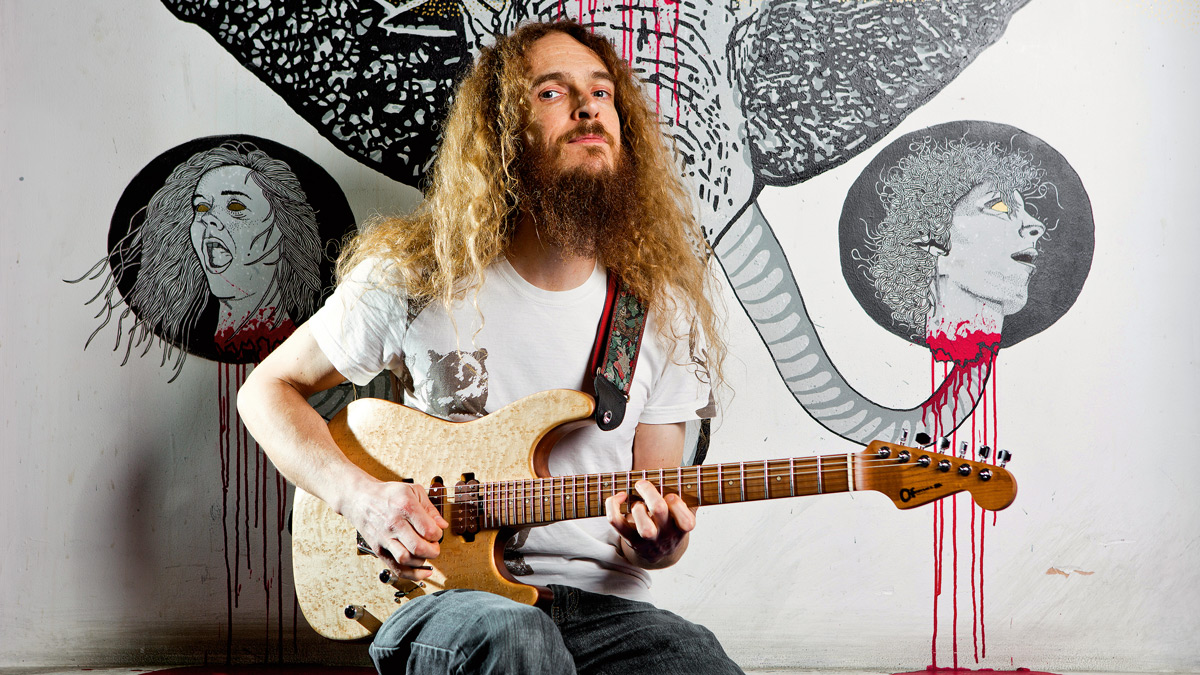
Some guitarists are born with music rushing through their veins, just as their fingers will later glide along the neck of that treasured, beautiful instrument with the same ease as their blood. It’s something innate, natural, singular and very much their own. Only a few come into the world with such a gift. They are the Chosen Ones. That is probably the case with Guthrie Govan.
“I started playing guitar when I was three years old.”
So it’s no surprise that he began teaching himself guitar at age three. At an age when reason is still relatively far off, Govan was already showing off an innate talent. But there is much more behind this great guitarist: a warm, approachable friendliness, a candid humility, a charming personality, a frank kindness and a sincere modesty. In short, talking with Guthrie and interviewing Govan turned out to be a real pleasure, much like the pleasure of listening to his brilliant technique and his command of a thousand and one styles. We are probably looking at one of the best guitarists of our time. He deserves it.
Let’s welcome the great Guthrie Govan. From ISP Music, we present a true artist, a first-rate craftsman. Enjoy this exclusive interview!
Guthrie, you’re considered one of the best modern guitarists. How does that feel?
Well... I just do what I do. It’s great that people like what I do, but I’ve never worried too much about what others think. I try to do what I think is right.
When did you start playing guitar?
I started playing when I was three... I really don’t remember. I was very young and the guitar was very big! (laughs)
I’ve read that you’re self-taught. Is that true? Why is that?
It’s true. My father taught me to play guitar. Then I started listening to all kinds of music to try to learn.
How many hours a day do you play these days?
Not enough. Honestly, I spend more time waiting in airports, sitting in embassies trying to get visas and answering emails (laughs). Though that’s cool too...
What’s your favorite guitar?
My Suhr signature guitar. I’ll show it to you. TA-DA!
Wow... It’s amazing!
It’s great! This one is my favorite.

But how many guitars do you have?
I have 15 guitars!
And could you tell me which guitarists have influenced you the most?
Oh! Lots of people. Mainly my father, who introduced me to the world of music. He’s the one who made me love music. Beyond that, I like the guitarists who started playing rock and roll in the 1950s, like Elvis, Jerry Lee Lewis or Chuck Berry. I think I’ve learned a lot from Scotty Moore, too. I’ve also been influenced by the blues thing, Eric Clapton in his ’60s period. I think that’s great. Then B.B. King. Also Jimi Hendrix and, of course, Jimmy Page.
Let’s talk about your gear. What do you expect from a guitar?
Mainly, a guitar that listens... It’s nice when a guitar responds differently depending on how you play the strings. In other words, it has a wide range of sounds and you can play its strings in different ways. In fact, for me, responsiveness is 50 percent; being easy to play would be 25 percent; and the remaining 25 percent is that it be reliable.
Reliability is very important to me because, for example, I was recently in South Africa, so my guitars travel a lot... If you take a piece of wood and subject it to sudden temperature changes and other hardships, that’s no good, because wood doesn’t like that. So I think a guitar has to give you confidence.
And what do you expect from an amp?
I think it should let you create sounds and preserve the way you play, let you use sustain and overdrive, but without losing the emotional charge.
How would you describe yourself, as a guitarist, as a musician, or both?
Well... I honestly don’t know. I think you have to be a musician to be a guitarist. You have to have the music in your head and “tell” the guitar what you need to create it. I love guitarists who do big things, deeper things, and who are interested in music.
Guthrie, you’re a very versatile guitarist, but when you play, which style of music do you feel most comfortable with?
I don’t know... I’m not the kind of person who focuses on that. I know there are great guitarists who do look for a stylistic source and become experts in one particular style and ignore everything else. I’ve spent my whole life getting distracted by everything (laughs). I like country, for example, blues, some classical, and I’m a jazz fan, though I like rock too. Still, I think the blues has a lot of personality. As you can see, I like all kinds of music... I think good music invites music. I focus on all of it.
You’re also an outstanding guitar teacher. What do you like most about teaching? And what do you like least?
I’ll start with what I like least (laughs). Sometimes I feel strange as a guitar teacher because I’m self-taught. It’s an unusual situation (laughs). But I try to teach students the way they might teach themselves... I think. The way I taught myself, the way I learned. I try to show them how good they are at some things, with humanity.
Another thing I don’t like about teaching is that it can swallow you up. Honestly, it’s one of the few jobs available today where you can make money as a musician. There are lots of guitarists who teach 50 hours a week, and they get lost in the whirlwind... and I refuse to let that happen to me.
Understandable... Plus, you have your own band, The Aristocrats...
Yes, The Aristocrats is my own band, the band I rehearse with here in my city. But I also do recording work for other people. That, and teaching, are things you do to make a living from the guitar. I never specifically set out thinking, “I want to be a guitar teacher”; it just happens. They’re things that are now part of my life.
Your great first solo album was called ‘Erotic Cakes.’ How would you describe it to our readers?
It’s instrumental music with lots of notes (laughs). Stylistically, I think it’s a mix of many things. You’ll find funky grooves, heavy grooves, and weird grooves too. I think it’s a fusion of different styles; it’s something original. It’s guitar music.
Why did you decide to call it that?
(Laughs) The Simpsons had a special Halloween episode in which Homer found himself on a street in the real world, the world you and I live in, and he got scared. Suddenly he saw a shop with a sign that said ‘Erotic Cakes,’ and Homer went in while all the humans stared at him. I thought it was a really funny episode... so that’s why I named my record that.
By the way, you were involved with the supergroup Asia... How was that? What did it mean to you? And for your career?
Well, I’m not sure what it meant for my career, but for me it was a great experience. At first I was hired as a kind of session guy to help them finish the whole album. That was around 1990 [actually, 2001]. It was a great experience for me because I went into the studio and played on the tracks, and I realized I was playing with real monsters. It all became very stimulating for me. Then they called me a few months later to join the tour as guitarist. And I said, “OK,” and I started living on a bus during the tour... It was a great learning experience for me, and I was immersed in music 24 hours a day.
Let’s talk about your band The Aristocrats. What are your plans?
We’ve been touring a lot this year. We’ve been to several countries in Asia, like Korea, Japan and so on. We’ve also been lost in the United States. We’ve been around Europe, we went to Turkey... In short, we’ve been touring this little world! (laughs). But our most immediate project is to release a live DVD we recorded in June in California, which sounds and looks great. We’ll also put out our new album in January, and we’ll tour Europe again.
You played with The Aristocrats in Spain last March... Will you be back?
Of course!
By the way, Guthrie, you can play like every great guitarist in the world, but have you found your own style?
Yes, I think I have. And I think every guitarist should care about finding their own style. You always try to sound a certain way or like a certain guitarist, and that’s good, because it helps you learn. But then you have to turn the page. You have to realize when you’re ready to move on to something else. You have to feel that it’s time; when you have that feeling, you no longer have a choice.
Over the past few years a lot of people have become interested in what I do, because of what I play and because I also teach in a magazine... In the end a reputation builds up, and sometimes people say to you, “Oh, you’re that guy who can play like other people.” But that’s never really what I wanted. It’s something you do for work, like playing a Steve Vai solo for a guitar magazine, for example. On the other hand, the internet is helping me get my own message out there and get people to listen to me.
Is it hard to be a guitarist these days?
Yes, I suppose so. These are confusing times for everybody.
To wrap up the interview, do you have any advice for ISP Music readers?
Let me think... There are a lot of guitarists who learn to play by ear, who look for their own identity... Some of those guys worry about learning a lot of technique and shut themselves in their search and say, “No, it’s impossible to know more.” But playing guitar means learning and growing. Some people have their own style and should go for it, because nobody can take it away from them. It’s a gift.
On the other hand, there are guys who go to a lot of clinics and things like that. I’ve met musicians there who started playing at 14, listening to John Petrucci, and tried to imitate every one of his scales and every one of his licks. They locked themselves in their room and tried to achieve the same thing he did. But then, once on stage, when they finally played with a band, they felt lost. All these kids need to realize that having great technique is wonderful, but you have to ask yourself, “Why do I play? Is there a reason I’m playing?” and so understand the reasons that bring you to be there. It’s not like being in high school and saying, “This week I’ll play faster than I did last week.” That’s fine, but if you want to play music, even without an audience, you have to write your own music. It takes a lot of effort.
That’s why technique shouldn’t be the only thing a guitarist focuses on. Often people play ridiculous speeches and make it look like they’re unhappy, because they don’t know what comes next and just focus on getting tricks and pressuring themselves. Above all, a guitarist should be happy with what he does.
There’s little left to say. We’ll just add: Guthrie, thank you so much for everything! And as Govan himself said: “Good music invites music.” Amen.
Editor’s note: The Aristocrats (Guthrie Govan, Bryan Beller and Marco Minnemann) have remained active. In February 2024 they released Duck, their fifth studio album, a concept record that tells the story of a duck’s escape from an Antarctic island to New York. In May 2026 they returned to Spain as part of their European tour, with six shows: Palma, Bilbao, Madrid (Teatro Eslava), Seville, Valencia and Barcelona. Meanwhile, Govan continues to collaborate with other artists; his most recent work is a guest solo on In Verses, the latest album from Australia’s Karnivool.

