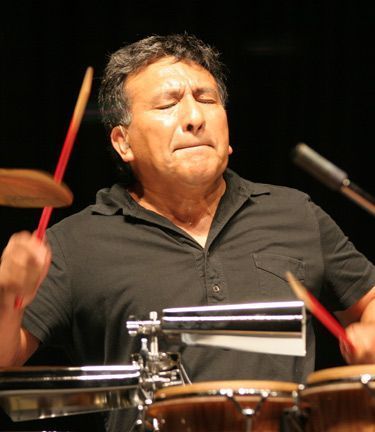
Pianist and flamenco singer, and also a bassist. Our publication is devoted to instruments and to those who make them sound with expression, mastery and talent. Going against the usual currents, throughout its pages it showcases what is "authentic," completely setting aside the commercial criteria that so often punish musicians in their creative processes because of the demands of record labels and, unfortunately, of the general public on many occasions.
We already knew this artist from our own experiences. In addition to the well-earned place he has made for himself among all our friends, contributors, musicians, etc., thanks to his know-how, and underlining our admiration after seeing his magic live a couple of months ago alongside Tomatito, we decided to offer our readers a new source of experience and musical wisdom through our now customary conversations among musicians at Instrumentos y Sonido Profesional
Despite this musician's great versatility, given his ability to masterfully express his talent through different disciplines and instruments, this issue, in which we present our special on bass (bass guitar), seems perfect for inviting another of the great musicians on today's Spanish (and international) scene. We welcome Diego Amador with great enthusiasm and gratitude.
Brief biographical notes
DIEGO AMADOR is also known as El Churri on the flamenco scene and in his neighborhood, the Polígono Sur in Seville. Diego is a musician twenty-four hours a day and a perfectionist who feels better in his home studio than anywhere else. Speaking of roots, DIEGO AMADOR's are there, in the area known as the 3000 Viviendas. The epicenter of many of the movements that have shaken up flamenco in recent years is, specifically, the Amador family home, where Churri grew up watching up close the adventures of his brothers Rafael and Raimundo (a.k.a. Pata Negra) and their curious relationship with success.
DIEGO AMADOR's future was decided the day his father came home with an old Hammond organ. Diego didn't hesitate for a second: he sat down on the stool, caressed the keys and started playing... por bulerías. Then came his professional beginnings, accompanying his brothers, La Susi, Tomatito, Argentine guitarist Luis Salinas, etc. His first album, the highly appreciable "Patita Negra," produced by Ricardo Pachón, already reveals his early passion for jazz. When Diego plays jazz, it seems as if he's inventing it, just as happened with his brothers when they played rock and blues.
Even so, DIEGO AMADOR is pure flamenco, and it is to this incomparable music that he swore eternal loyalty on the altar of art, sponsored by Euterpe, Polyhymnia, Terpsichore, Pastora Pavón and Fernanda de Utrera. There is nothing accidental about his work, which pursues the goal of so many young musicians in recent times: to turn the singing and playing of the Andalusian Gitanos into the great universal flamenco music. Churri is the most gifted musician of his generation for bringing about a qualitative leap in that evolution.
Interview
Dear Diego, first of all, on behalf of the whole team and our readers, thank you for taking part and for your kindness.
Introducing this interview as a learning opportunity for many of the people reading you right now: what were your first contacts with music, and what made you choose this professional path?
My first contacts were with flamenco, from a very young age. In my neighborhood we used to play at being artists: we'd grab the guitar, head downstairs, some played, others sang, we had something to drink and we felt like real artists.
I was on stage from a very young age, and I never had time to think about what my profession would be. By the time I realized it, I was already in music, and I was a professional.
It's not very common to see the skill you have channeled into several instruments. What need led you to develop several disciplines, and which instruments do you feel most comfortable with, besides bass?
The truth is that I loved music so much, and at the same time I saw it so clearly, that I composed and wrote arrangements for the people around me, and I realized they weren't playing what I wanted. And the solution was to record my own arrangements, so I ended up playing piano, guitar, percussion, whatever I felt was needed.
I feel comfortable with the piano, the guitar and the drums and, if you consider it an instrument, singing.
The last time we had the chance to hear you live, we noticed (among other things) great personality in your bass lines, transforming the supporting rhythmic lines into melody, in an especially interesting cross between foundation and melody. How do you understand the instrument (bass)? Does it perhaps depend on the freedom the other artists on stage give you?
My primary way of understanding it is as a foundation. But in flamenco I use melody, because the guitar falsetas can be doubled. As long as it provides the foundation, and there's a spot where the guitar doesn't need it as much, it can be enriched, as I was saying, by doubling a falseta, for example. In flamenco the bass isn't a common instrument, and if it's there, it's good for it to enrich the music.
On stage I try to play my own style, my own way of playing, whatever the instrument, always in agreement with the person who is playing. I can adapt, but never lose my signature.
Speaking of basses, which bass or basses do you use at the moment, which are your favorites and why did you choose them? What characteristics does this instrument need to have for you to consider it "good"?
The truth is that I'm not very interested in basses. Finding one you like can be difficult and easy at the same time. The one I use is an inexpensive bass, and I like it a lot. I've adapted it to my taste, by removing the frets, for example. But I believe the sound you can get out of it is in the musician's hands, not in the brand.
As for bass amplification, do you have any brand preferences? What should you look for in a bass amp?
I don't use amplifiers. In that sense, flamenco musicians are a bit like classical musicians: the cleaner the sound, the better. On stage I ask for the opposite of any bassist: that they completely cut the bass pickup. I only use the treble pickup, so the sound isn't so fat.
Moving on to your personal projects, what are you working on at the moment? In terms of recordings? And live?
I've just presented my latest album, "Piano Jondo," in the USA, I'm producing an album for flamenco singer Potito, and I keep giving my concerts as a pianist and singer.
I'm also accompanying Tomatito on bass and mandolin.
In all our interviews and comments for readers, we always conclude that it's important to know how to convey feeling as well as to progressively perfect technique, since each on its own leaves serious shortcomings in a player, whereas together they make the musician a necessary "whole." With that in mind, we'd like to use this space to invite you to share, openly and freely, your advice for all those who are just starting out, as well as for intermediate and advanced players. What would you say to everyone reading you so they don't get discouraged, keep working and become great musicians?
First, study a lot and listen to good music, which is the best school. Play along with the records you like most. Don't be in a hurry; that's how you get further. And finally, don't worry about buying expensive instruments. Everything is in the hands and the heart of the musician.
Best regards. Diego Amador
Finally, with our respect and warm regards, we congratulate you on your work and wish you the greatest possible exposure, which your work undoubtedly deserves. We feel that the fusion of styles, techniques, musical origins, trends, etc. is a remarkably enriching element for performers and creators. So I hope all readers of Instrumentos y Sonido Profesional make the most of the contribution you, as the exceptional musician you are, have shared with us, joining our pages on this occasion. Thanks to Diego Amador.